Operation Praghat - dismantling Imam Mahmuder Kafila (IMK)/ Indian Mujahideen-k (IMK) module in the North-East Region
 usanasfoundation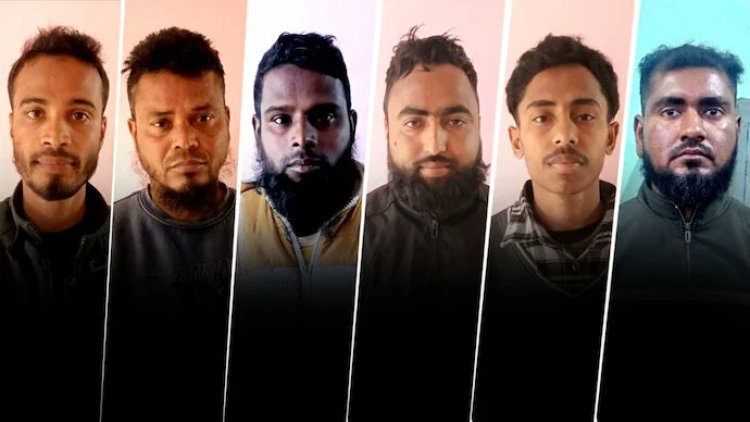
Analysis
By Ujjual A Jha
- Incident. Indian security and intelligence agencies carried out coordinated searches (Operation was named "Operation Praghat") on the night of 29-30 Dec 2025 at multiple locations in Assam (Barpeta, Chirang, Baksa and Darrang Districts) and Tripura, which unearthed a radical extremist network active in North East, specifically in Assam and Tripura. A total of 11 suspects were arrested, ten from Assam, one from Tripura and were reportedly part of Imam Mahmuder Kafila (IMK), also referred to as Indian Mujahideen-K (IMK). The suspects arrested are as follows: -
|
Suspect Arrested |
Age |
Arrest Location |
Reported Role |
|
Nasim Uddin (alias Tamim) |
24 |
Barpeta Road, Assam |
Identified as Head of IMK Assam. |
|
Jagir Miah |
33 |
West Jaipur, Agartala, Tripura |
Active operative. |
|
Junab Ali |
38 |
Chirang, Assam |
Form a sleeper cell and planning. |
|
Afrahim Hussain |
24 |
Darrang, Assam |
Recruitment and digital radicalization. |
|
Mizanur Rehman |
46 |
Barpeta, Assam |
Senior member, logistic support. |
|
Sultan Mehmud |
40 |
Barpeta, Assam |
Local organiser for the fund and coordination. |
|
Md Siddique Ali |
46 |
Barpeta, Assam |
Radical Literature |
|
Rasidul Aalam |
28 |
Baksa, Assam |
Expand organisation in lower Assam. |
|
Mahibul Khan |
25 |
Baksa, Assam |
Active member, 'Purva Akash' communication network. |
|
Sharuk Hussain |
22 |
Barpeta, Assam |
New recruit. |
|
Md Dilbar Razak |
26 |
Barpeta, Assam |
Youth recruitment and 'bayat' network. |
- IMK. IMK, a Bangladesh-based radical/ extremist organisation, is an offshoot of the banned Jamaat-ul-Mujahideen Bangladesh (JMB) and was formed in 2018 by former JMB operatives. Its founder and leader was Jewel Mahmud (also known as Imam Mahmud Habibullah or Sohail), a former member of JMB, and declared himself as Amir of IMK.
- Ideology. IMK promotes a violent extremist ideology referred to as “Ghazwatul Hind” (also called Ghazwat-e-Hind), which seeks: A militant struggle against India, intending to establish Muslim dominance through armed conquest. It uses jihadist propaganda and radicalisation to recruit and motivate supporters.
- Recruitment. IMK module is stated to have pioneered a decentralized recruitment that leverages both traditional religious spaces and sophisticated digital platforms. The "Purva Akash" (Eastern Sky) group, an encrypted social media community, has been identified as the primary engine for indoctrination and recruitment. Recruitment process follows a systematic path as explained below: -
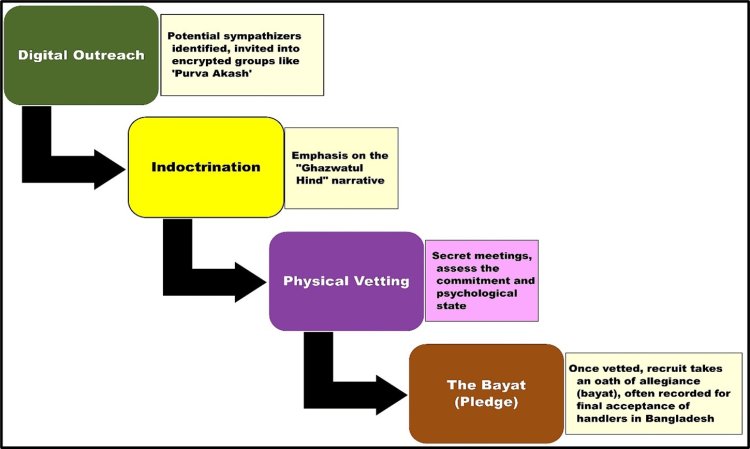
Recruitment Process
5. Funding & Logistics Elements. The funding can be divided into trans-border and local/ domestic fund mobilisation. The details of funding and logistics elements are tabulated below: -
|
Fund/ Logistic Element |
Usage |
|
Hawala |
The primary method for cross-border transfers to fund training in Bangladesh. |
|
UPI/Bank Transfers |
Used for local logistics and operations. |
|
Passports and Visas |
Use of valid legal documents to travel to Bangladesh. |
|
Border Gaps primarily Riverine |
Infiltration routes without documents. |
|
'Purva Akash' Group |
Centre for financial mobilization and digital indoctrination. |
- Linkages. IMK, although an offshoot of the JMB, has maintained deep ties with its parent organization. Reportedly, it has aligned itself with Ansarullah Bangla Team (ABT) and Al-Qaeda in the Indian Subcontinent (AQIS). The nexus makes IMK a component of a larger transnational jihadist ecosystem rather than an isolated actor.
- Analysis of Arrests.
7.1 Primary Bases. The arrests highlight Lower Assam as the main base of radical activities, north of the Brahmaputra River.
7.2 Use of Geography & Demography. The areas of arrest have geographical lanes to move in and out of India to Bangladesh and vice versa. The mixed demographic profile in these areas has further boosted the geographical aspect to support the bases. In addition, these areas also provide a certain amount of anonymity to the radical/ extremist elements.
7.3 Barpeta, Assam as Ideological & Logistic Centre. Barpeta has emerged as the centre of the module (six arrests out of 11 from Barpeta). In past, the JMB and other radical elements have been arrested in Barpeta. Also, the place is along the NH, provides easier access and anonymity, acts as a gate to the Bodoland Territorial Region (BTR) and also provides proximity to the Bhutan border. In addition, Baksa, Chirang and Darrang have also past links with PFI with respective district committees.
7.4 Tripura - Transit & Shelter. The geographical location of Tripura helps in transit movement and also providing safe haven to the radicals.
7.5 Importance of Inter-State Police Cooperation. This inter-state operation explains its importance to neutralise modules that operate across the permeable internal borders.
- Security Implications for Northeast India. The resurgence of Bangladesh-based radical modules poses a threat to the fragile stability of Northeast India.
8.1 Siliguri Corridor. The activities of the IMK are concerning, given their proximity to the Siliguri Corridor. The creation of sleeper cells across Assam and further to West Bengal could be part of a long-term strategy to possibly disrupt this corridor during a crisis.
8.2 Demographic and Social Impact. The past history of communal tension and migration issues and subverting youth with extremist propaganda, can fuel tensions between different ethnic and religious communities, leading to a self-reinforcing cycle of instability.
8.3 Indo-Bangladesh - Vacuum of Security Cooperation. The downfall of the security consent that existed between India and Bangladesh, primarily due to the approach of the interim government in Bangladesh, has created a vacuum that is being filled by anti-India elements. The potential exists for transforming the India - Bangladesh border into a "porous and hostile" one, which is a grave concern for the Indian internal security system.
8.4 Legal Status. IMK is not officially a proscribed terrorist organisation, but has the potential to destabilise the North East Region due to its ideology and links with banned organisations.
- Way Forward with Reference to the Bangladesh Situation
9.1 Border Management Modifications. There is a need to implement the Comprehensive Integrated Border Management System (CIBMS 2.0), custom-made to the unique riverine and hilly terrains of the North-East. In addition, deployment of multiple sensors is required to cover the areas where physical fencing is not practical. This necessitates a review of equipment and tactics for BSF, keeping in mind the changed scenario and emerging security dynamics.
9.2 Intelligence Renovation. A two-pronged approach is needed to counter these transborder activities, one strengthening its own set-up with Cyber aspects in mind and focusing on border areas not just for infrastructure development but also for intelligence gathering and fostering a sense of nationalism.
- Legal Aspects. Strong implementation of legal provisions is required to regulate entry and exit and to control radical activities.
9.4 Diplomatic Approach - Diversifying Engagement. The political transition in Bangladesh calls for a move beyond India’s historical reliance on a single political entity. There is a requirement to engage with present stakeholders to manage the transition and ensure that Indian security interests are met. Leveraging regional forums can provide a platform for better security coordination.
- Operation Praghat has significantly dented the IMK module, but it also highlights the evolving threat landscape. The ideology of "Ghazwatul Hind", operational expertise of JMB and the vacuum in Bangladesh create a potential threat to the security situation in Nort-East Region. There is a need of multi-prolonged approach combining intelligence, technology, diplomacy and legality to ensure stability amidst a changing landscape.
Disclaimer: This paper is the author's individual scholastic contribution and does not necessarily reflect the organization's viewpoint.
Ujjual A Jha is a certified IR and diplomacy expert with two decades of experience in the field. His key specialised fields are South Asia, cross-border conflict dynamics, counter-terrorism and illicit finance mitigation.