Bangladesh’s contested election and the rise of Islamist Influence
 usanasfoundation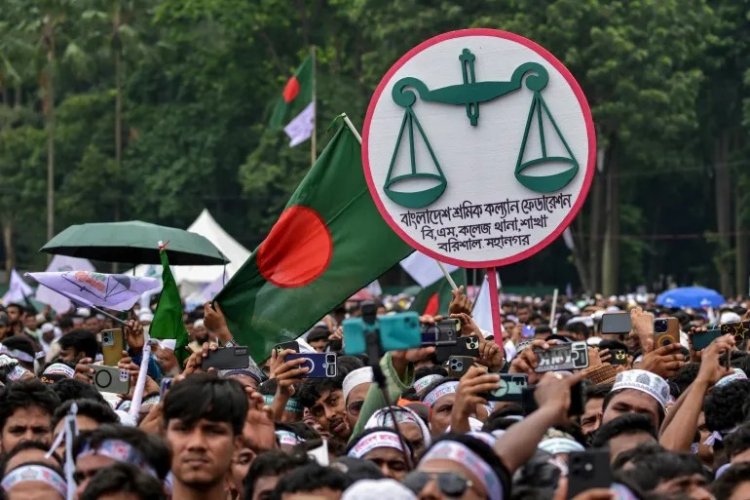
Analysis
By Salah Uddin Shoaib Choudhury
As Bangladesh approaches its February 12 general elections, concerns are mounting among analysts about the long-term implications of political exclusion, rising Islamist influence, and growing social polarization. What makes this moment especially troubling is not only Jamaat’s resurgence, but the systematic removal of democratic checks that might otherwise restrain it.
Jamaat-e-Islami, an Islamist party with historical links to the Muslim Brotherhood, is widely expected to perform strongly in an election marked by the absence of major political competitors. The interim Yunus administration’s decision to bar the Awami League and several other parties from participation has fundamentally altered the electoral landscape.
Supporters of the move argue it was necessary to stabilize the country. Critics contend it has undermined democratic pluralism and opened space for ideological consolidation.
Jamaat’s re-emergence has been framed by some international outlets as a return to political participation following past restrictions. However, the party’s ban lasted only weeks prior to the 2024 elections, following allegations of extremist involvement. The current environment represents a far more consequential shift.
Since Sheikh Hasina’s relocation to India, Islamist organizations have become increasingly vocal. Advocacy for restrictions on cultural events - including music, theatre, and women’s sports - has intensified. While proponents describe these measures as moral safeguards, opponents view them as part of a broader effort to reshape public life.
Reports of attacks on Sufi shrines and intimidation of minority communities have further heightened tensions. According to Pew Research Center, Bangladesh’s population includes
Hefazat-e-Islam has emerged as an influential grassroots actor, mobilizing extensive madrassa networks. Its recent engagement with Afghanistan’s Taliban - through reciprocal visits - has prompted debate over ideological alignment and regional implications, though concrete outcomes remain unclear.
Electoral integrity has become another focal point. Videos circulating on social media appear to show irregular handling of postal ballots by political actors. While the authenticity of these materials has not been independently verified, their circulation has contributed to public skepticism.
For Bangladesh’s Hindu community, the situation is even more harrowing. A BBC report revealed that Hindus feel trapped between rival political forces - fearful of Jamaat reprisals if they support the BNP, and BNP hostility if they are seen as backing Jamaat. Many describe themselves as being treated like a “football”, kicked between hostile camps, their safety reduced to a political afterthought.
The effects of political instability are already being felt. Al Jazeera has reported growing anxiety among Indian medical students studying in Bangladesh amid rising nationalist and religious rhetoric. Student organizations have appealed to Indian authorities for intervention.
International reactions have so far been cautious. Statements by British MP Priti Patel and Pope Leo XIV have drawn attention to minority rights, but broader diplomatic engagement remains limited.
Bangladesh’s elections will test not only domestic political resilience, but also the region’s ability to manage ideological polarization without escalation. For regional stakeholders, the priority may lie less in predicting outcomes than in assessing how political exclusion reshapes long-term governance and social cohesion.
Disclaimer: This paper is the author's individual scholastic contribution and does not necessarily reflect the organization's viewpoint.
Salah Uddin Shoaib Choudhury is an award-winning journalist, writer, and Editor of the newspaper Blitz. He specializes in counterterrorism and regional geopolitics.