Tense Coexistence: Rohingyas under Arakan Army Rule
 usanasfoundation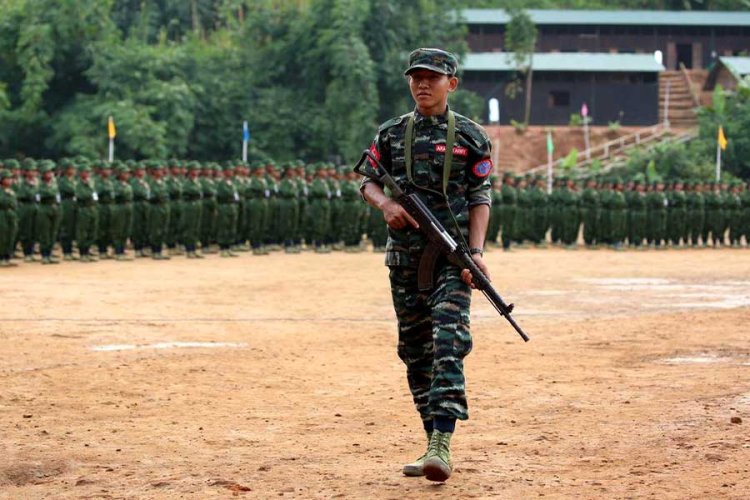
Analysis
By Usanas Team
Edited By Preeti Khenta
In the ongoing internal conflict in Myanmar, the Arakan Army has emerged as one of the most influential Ethnic Armed Groups (EAGs), wielding significant control over large parts of Rakhine State. The Rohingyas are a marginalized Muslim minority in this region, faced severe persecution primarily after the 2017 military operation, which forced around 7,40,000 Rohingyas to flee to Bangladesh. Currently, they are under the control of the Arakan Army in the Rakhine State. Earlier, the Arakan Army took a cautious approach and avoided engaging with the Rohingya issue due to its sensitivity among the Rakhine Buddhist population. However, as the Arakan Army has consolidated its de facto governing power in the region, its stance has gradually evolved from silence and exclusion to a more pragmatic coexistence. This rearrangement is essential to understand the current dynamics of governance, security, and ethnic relations in western Myanmar.
The Arakan Army (AA) was formed in Apr 2009 under the political wing known as the United League of Arakan (ULA) by Major General Twan Mrat Naing and Brigadier General Nyo Tun Aung. The group was initially trained under the Kachin Independence Army (KIA) in northern Myanmar, before expanding itself in Rakhine and Chin States. Its stated objective is to achieve “self-determination, equality, and autonomy” for the Rakhine people within a federal democratic union of Myanmar. Since 2015, the Arakan Army has increased its capabilities in terms of both strength and combat potential and emerged as one of the most organised and effective EAGs in Myanmar. The ULA runs its own civil governance system, while military matters are dealt with by the Arakan Army.
The Arakan Army initially allied with the Three Brotherhood Alliance alongside the KIA, Ta’ang National Liberation Army (TNLA) and Myanmar National Democratic Alliance Army (MNDAA); however, subsequently, it has focused on an independent political path for Rakhine autonomy. The Arakan Army’s growing influence makes it a key factor in Myanmar’s political landscape, post-military transfer of power on 01 Feb 2021.
The Rohingyas are a Muslim ethnic minority primarily inhabiting Rakhine State, Myanmar, along the Bangladesh border. Their historical account demonstrates their long-standing settlements in the Arakan region, with cultural and linguistic roots linked to both local Arakanese and South Asian communities. The community speaks the Rohingya dialect, closely related to the Chittagong dialect and practices Sunni Islam. Historically, Rohingyas were recognised as one of the native groups of Burma (now Myanmar). However, following the Citizenship Law of 1982, they were excluded from Myanmar’s list of official ethnic nationalities, rendering them stateless. This exclusion has stripped them of fundamental rights such as education, freedom of movement and political participation. In August 2017, Myanmar Army clearance operations, post attacks by Rohingyas, led to one of the world’s largest refugee crises, with over 740,000 people fleeing into Bangladesh. Meanwhile, around 600,000 Rohingyas remained in Myanmar, mostly confined to camps or restricted villages under tight surveillance. International observers, including the United Nations, described the violence against them as “ethnic cleansing” and potentially even “genocide.”
Over the decades, several Rohingya organizations have emerged, each adopting different strategies ranging from political promotion to armed resistance. One of the most notable groups is the Arakan Rohingya Salvation Army (ARSA), led by Ata Ullah, which gained prominence in 2016–2017. ARSA, claimed to defend the community against military abuses, but was accused of triggering mass reprisals through its attacks on security posts. Earlier, in the 1980’s, the Rohingya Solidarity Organization (RSO) was formed with an aim of seeking autonomy, but it eventually weakened due to internal divisions and external pressure.
On the political front, groups such as the Arakan Rohingya National Organization (ARNO) and the Rohingya Union have focused on international advocacy, human rights documentation and diplomatic engagement through global bodies such as the Organisation of Islamic Cooperation (OIC) and the United Nations. Additionally, civil-society and diaspora-led initiatives, such as the Rohingya Human Rights Initiative (RHRI) and Rohingya Youth for Legal Action (RYLA), are dedicated to promoting awareness, youth leadership and humanitarian relief, primarily in the refugee camps of Bangladesh and Malaysia.
While the Rohingya movements remain fragmented and lack unified representation, they are united in their quest for citizenship restoration, safe repatriation and international recognition as an indigenous ethnic group of Myanmar. The Arakan Army has maintained a cautious and evolving stance toward the Rohingya Muslim community. The phases of AA's stance on the Rohingyas are as follows.
Phase I - 2009 - 2015: Focus on Rakhine Nationalism. AA refrained from engaging in public with Rohingya issues instead aligning itself with Rakhine Buddhist Nationalist narratives, which rejected the Rohingya ethnic identity. During this period, the AA's focus was on promoting Rakhine self-determination and resisting central domination by the Myanmar Army, without addressing intercommunal relations.
Phase II - 2015 – 2018: Hostile Stance. In the aftermath of the 2017 Rohingya crisis, which saw the mass exodus of over 740,000 Rohingyas to Bangladesh following post-military “clearance operations,” the Arakan Army began to alter its tone. The organization started describing the Rohingya as Bengali Muslims and chose to remain silent on the atrocities and refrained from condemning the military actions. The Arakan Army aligned with anti-Rohingya sentiments to retain its standing in Rakhine State.
Phase III - 2019 – 2022: Shift of Stance – Hostile to Pragmatic. The gain of control of Rakhine State by AA led to a change in the stance of AA, keeping in mind the aim of local governance. The stance was changed from Bengali Muslim to Muslims in Rakhine with basic rights, however, without citizenship rights. Governance needs drove the shift, and AA reportedly received some support from Rohingya elders. AA continued rect and taxation in the Rohingya inhabited areas.
Phase IV - 2023 – 2025: Shift of Stance – Two-fold Policy. The AA gained control of almost the entire Rakhine State and commenced local governance. However, this led to clashes between AA & Rohingya organizations in Maungdaw & Buthidaung. The stance of AA softened with statements stating all residents should live peacefully, avoiding specific mention of the Rohingyas. This two-fold policy was adopted to create an inclusive image at the international level while maintaining a restrictive policy in Rakhine State.
Overall Present Status: Arakan Army Stance on Rohingyas. The Arakan Army adopted a pragmatic and politically calculated stance toward the Rohingyas in Rakhine State. Post-consolidation in much of Rakhine State, AA has established a self-administered system through its political wing, the United League of Arakan (ULA). They have enforced civil administration, local taxation, law enforcement and dispute resolution mechanisms, although with limited involvement of the Rohingya community. The organization has refrained from formally recognising Rohingyas but refers to them as “Muslims in Arakan”, which is more inclusive in nature, primarily to present a positive shift at International Forums.
International observers, including Amnesty International and the International Crisis Group (ICG), have characterized the current situation in Rakhine State as “tense coexistence under parallel governance”. The AA is seen neither as actively persecuting nor integrating the Rohingyas but rather maintaining a delicate balance to consolidate its authority, while avoiding alienation of the ethnic Rakhine Buddhist. While the forums have dismissed the claims of Ethnic Cleansing by AA, they have acknowledged the presence of discriminatory governance.
Assessment
Although the Arakan Army advocates for political goals for Rakhine-based ethnic groups, their stance on the Rohingyas remains ambivalent. The evolution of AA's position shows progress, shifting from hostility to neutrality, pragmatic, while maintaining Rakhine Buddhists as the core policy focus. The Arakan Army's change of stance seems to aim for legitimacy from an international forum for its inclusive local governance.
Arakan Army's stance toward the Rohingya echoes a pattern of exclusion, despite its claims of building a multi-ethnic administration. The ongoing conflict and humanitarian crisis in Rakhine State show that the Rohingya remain trapped between warring parties and are more of a political tool than rightful citizens. Overall, without a fundamental change in the Arakan Army policies, peace for the Rohingya in Rakhine State is not feasible.
Disclaimer: This paper is the author's individual scholastic contribution and does not necessarily reflect the organization's viewpoint.