Shadows Across The Border: Growing Radicalisation And Terrorism in The Rakhine-Chittagong Strip
 usanasfoundation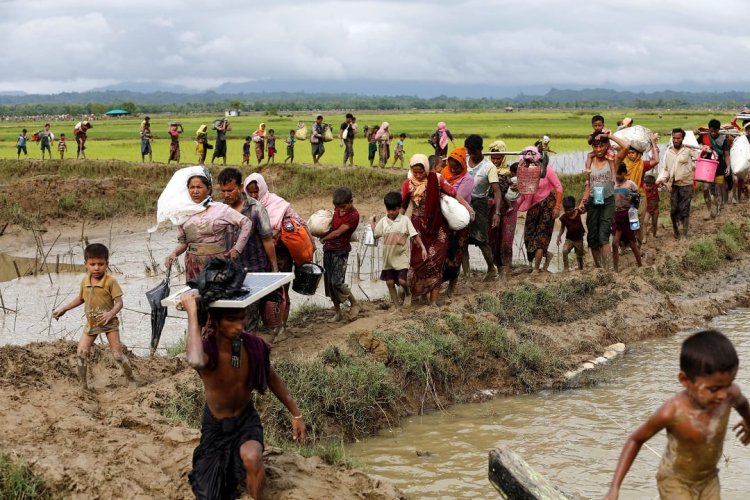
Analysis
By Lt Col Ujjual Abhishek Jha (Retd)
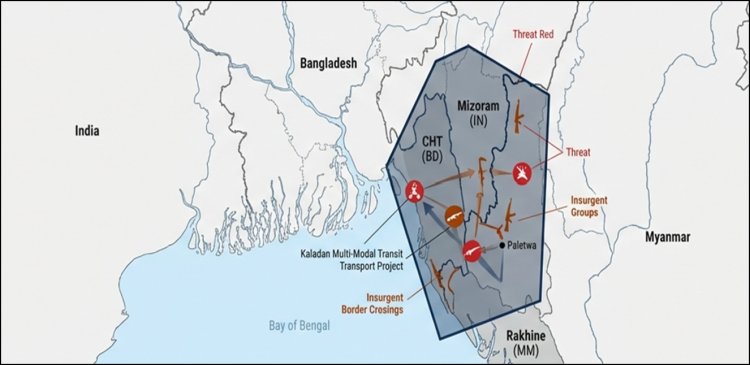
The Rakhine-Chittagong corridor has emerged as one of the most complex security zones in South-East Asia. The border along Chittagong Hill Tracts (CHT), Bangladesh and Rakhine State, Myanmar, which has traditionally had distinct grievances, rooted in the ethnicity and identity issues, against their respective governments, is now witnessing an emergence of religious radicalisation alongside ongoing ethno-nationalist movements. The political transition in Bangladesh in mid-2024 dismantled a decade-long counter-terrorism framework and triggered a security vacuum, allowing systematic exploitation by global terror outfits and Rohingya extremist groups. The cumulative effect transformed a localized struggle for autonomy into a transnational security crisis that threatens the stability of the North-East Region (NER), where cross-border ethnic ties and logistical corridors facilitate the spillover of conflict.
Historical Foundations of Instability
The current security crisis in the CHT-Rakhine passage is not a spontaneous phenomenon. It is deeply rooted in decades of systemic marginalisation, failed peace processes and the deliberate manipulation of religious and ethnic identities by both state and non-state actors.
Rohingya Issue: Statelessness to Transnational Insurgency
The roots of the current security crisis in Rakhine State extend to the deliberate legal exclusion of the Rohingya Muslim minority by successive Burmese governments. The defining legislative act was the 1982 Citizenship Law enacted under General Ne Win's military government, which deprived the Rohingyas of citizenship by restricting nationality to 135 officially recognised ethnic groups. This rendered approximately one million people effectively stateless. This systemic exclusion produced the conditions for organised armed resistance with the formation of the Rohingya Solidarity Organisation (RSO) in the 1980s, reportedly with covert assistance from the Bangladesh Army, and became the initial Rohingya militant formation, seeking autonomy in northern Rakhine (then Arakan) and operated with sporadic cross-border incursions and limited international support. The conflict underwent an escalation with the communal violence of 2012 between Rakhine Buddhist and Rohingya Muslims, resulting in mass displacement of Rohingya into de facto camps. The clearance operation by the Myanmar Army (MA) in August-September 2017 caused the displacement of approximately 7,50,000 Rohingya into Bangladesh, creating the largest refugee settlement at Cox's Bazar. This transformed the nature of Rohingya armed resistance from isolated insurgency to transnational security concern with captive recruitment pool, diaspora funding networks and focus of global jihadist organisations seeking to frame the persecution as an anti-Muslim campaign demanding armed response. The refugee camps at Cox's Bazar became a hotbed of criminals and an operational environment for militant recruitment and organisation.
Rakhine: Rise of Arakan Army (AA) and Present Landscape
The rise of the AA has significantly reshaped the threat landscape in Rakhine State. The AA has gained control of a large part of Rakhine State and has begun local governance. The AA has adopted a pragmatic and politically calculated stance towards the Rohingyas in Rakhine State. But for the Rohingyas, this liberation has felt more like a new nightmare. Despite the AA’s promises of inclusive governance, the reality on the ground has been grim, marked by targeted violence, systemic destruction, and the intensification of fear among the Rohingyas.
Chittagong Hill Tracts (CHT): Ethnic Autonomy to Radical Extremism
Within Bangladesh, the CHT has been a theatre of ethno-nationalist conflict since independence, with indigenous communities including the Kuki-Chin, Chakma, Marma, and other hill peoples engaged in prolonged struggles for territorial autonomy against the government of Bangladesh. The systematic exploitation of this established ethnic militant infrastructure by Islamist jihadist organisations by forging a tactical operational partnership with a non-Muslim ethno-nationalist group signals CHT transitioning to an active operational hub for transnational Islamist militancy.
CHT: Linkages - Ethno-Nationalists and Islamist Groups
The conflict in the CHT is rooted in the struggle for autonomy by the Jumma people (comprising 11 ethnic groups, predominantly Buddhist, Hindu, and Christian). In CHT, the primary aim of ethno-nationalists is autonomy, and linkages with Islamic groups seem fluid and tactical intersection and not a formal alliance. The emergence of the Kuki-Chin National Front (KNF), a bawn ethnic group (Kuki-Chin linguistic family), has been reported to have linkages with Jama'atul Ansar Fil Hindal Sharqiya, an Islamist group links. The reasons for the links are that CHT has rugged terrain and provides a safe haven in respective areas of dominance, and also logistic and training support to each other. While tactical collaborations exist, the partnership differs by fundamental clash of core identities: -
|
Aspects |
Ethno-Nationalist Groups (Chakma, KNF) |
Islamist Groups (JMB, JAFHS) |
|
Aim/ Goal |
Autonomy and land rights. |
Establishment of a caliphate or Sharia-based rule. |
|
Identified as |
Secular or religious minority (Buddhist/Christian). |
Radical Islamic Extremism. |
|
Territorial Philosophy |
Ancestral home, protected from outsiders. |
Base for broader regional operations. |
Political Transition of 2024 & Counter-Terrorism Vacuum
Fall of the Awami League Government
The political turmoil in Bangladesh during July-August 2024 culminated in the forced resignation of Prime Minister Sheikh Hasina under sustained mass protest pressure and withdrawal of military support, the most significant shift in regional security in more than a decade, which changes everything. The formation of an interim government under Dr Muhammad Yunus led to the structural dismantling of counter-terrorism measures. The diversion of specialised counter-terrorism forces to conventional crime management and internal security tasks resulted in a low priority for monitoring radical threats and created a security vacuum.
Security Collapse
The security consequences of the 2024 transition are stark and measurable, which contributed to the rise of radical extremism and reached the CHT area, too. The table below indicates security deterioration and implications: -
|
Security Failures |
Outcome |
Implication |
|
Prison Escapes (since August 2024) |
Approx 2500, 70-80 confirmed terrorists |
Reconstitution of old hand radical leaders |
|
Small Arms Looting |
Approx 6000 weapons |
Proliferation of weapons to extremist groups |
|
Attacks on Minority Communities |
More than 700 reported police cases |
erosion of secular fabric and communal polarisation |
|
Radical Digital Subscriptions |
Approx growth of 2100 % (2020-2026) |
Exponential growth in extremist ideological |
|
Foiled Embassy Attack |
US Embassy plot, July 2025 |
Escalation of sabotage targets |
Profiles of Islamic Extremist Organisations
Jama'atul Ansar Fil (Phil) Hindal Sharqiya (JAFHS/JAPHS)
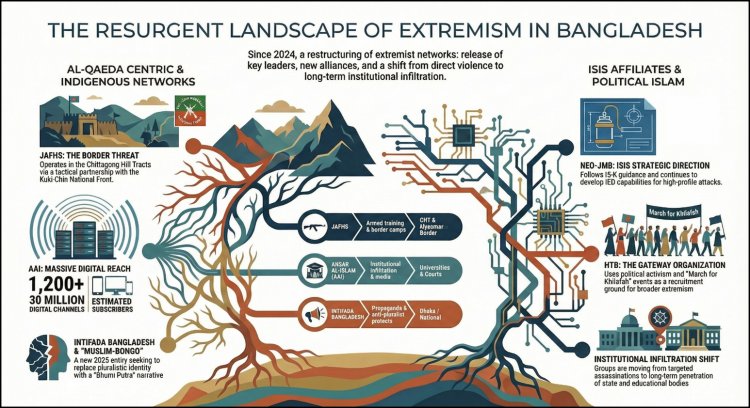
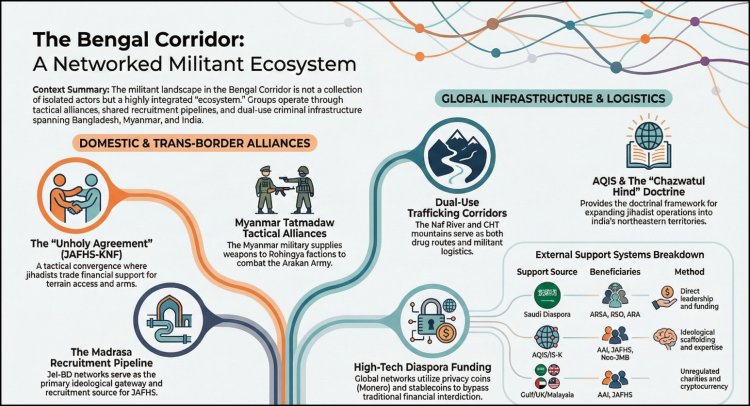
JAFHS has emerged as a significant threat along the Bangladesh-Myanmar border. It was formed between 2017 and 2019 by Shamin Mahfuz and conceptualised by prison inmates belonging to Jamaat-ul Mujahideen Bangladesh (JMB) and Harkat-ul Jihad al-Islami Bangladesh (HuJI-B), and subsequently it emerged as a unified platform for Al-Qaeda-aligned remnants. The core ideology of JAFHS is the idea of Ghazwat-ul Hind, i.e., the Islamic conquest of India. It is in CHT and Rakhine State, as the Hindal Sharqiya (Eastern India/Eastern Subcontinent). JAFHS has an internal architecture consisting of a missionary unit (Dawah), led by Abdullah Maymun, for recruitment and indoctrination through madrasa networks across Bangladesh, and an armed wing, under Chief Coordinator Rafat Sadik, for training. Finances are derived from madrasa collections across Bangladesh, donations from Arab countries, and front businesses in the Bandarban District of the CHT. JAFHS has forged a tactical operational partnership with a non-Muslim ethno-nationalist group, the Kuki-Chin National Front (KNF), providing JAFHS with access to remote training camps and arms procurement routes in CHT. The group was officially banned in Bangladesh on 10 August 2023, though the situation turned in their favour post October 2024. The release of Deputy Chief Mohibullah in 2025 significantly enhanced the group's organisational capability. The group is active in CHT, Sylhet, and Dhaka in Bangladesh, and in Rakhine in Myanmar. The reported linkages include Pak ISI, Al-Qaeda (AQIS), Rohingya Solidarity Organisation, Arakan Rohingya Salvation Army, Jamaat-e-Islami Bangladesh, and KNF.
Ansar al-Islam (AAI) / Ansarullah Bangla Team (ABT)
AAI, also known as Ansarullah Bangla Team (ABT), serves as AQIS's primary affiliate in Bangladesh. The ideological base of AAI is rooted in Qutbist tradition (derived from Egyptian Islamist thinker Sayyid Qutb's doctrine of revolutionary vanguard jihad against apostate governments) and the influence of Al-Qaeda ideologue Anwar al-Awlaki. AAI has historically focused on targeted assassinations of secular bloggers, activists, and writers through small, deniable cells. The most significant evolution of AAI, according to internal documents, is a shift from direct violence to a process-based, long-term infiltration of state institutions, universities, courts, and educational bodies through decentralised Dawah Circles. This idea is reinforced by a sophisticated and expansive media infrastructure in which AAI and affiliated links operate over 1,200 digital channels (through platforms including YouTube, Facebook, and Telegram), with an estimated 30 million subscriptions, disseminating ideological content.
The release of Mufti Jasimuddin Rahmani, the ideological chief of AAI, in August 2024 was consequential, with Rahmani issuing public statements calling for the revival of separatist movements in Kashmir and North East India. This also indicates attempts by AQIS-aligned groups to exploit the current regional instability to expand their operational reach into Indian territory.
Intifada Bangladesh (IB)
Intifada Bangladesh (IB) emerged in 2025 as an organisation linked to Al-Qaeda-centric networks, with a primary focus on redefining Bangladesh's national identity through the 'Bhumi Putra' (Sons of the Land) narrative, seeking to nullify the pluralistic Bangladeshi national identity and rename the country Muslim-Bongo. IB follows the ideology of theocratic extremism and takfiri jihadism, and its stated objectives include the total dismantling of the democratic system and the establishment of Sharia law. Its propaganda architecture uses Facebook as a primary channel for violent content, including material depicting Osama bin Laden as a national hero. In July 2025, IB organised a protest in Dhaka demanding the removal of the UN Human Rights Office, calling it a front of Western political interference. The present leadership, Mufti Jasimuddin Rahmani and ideologue Asif Adnan, former terror detainees, validates its deep integration with established jihadist networks that predate the post-2024 security vacuum. This is not a spontaneous formation but a deliberate organisational effort.
Neo-JMB (Islamic State Affiliate)
Neo-JMB, an Islamic State-affiliated group, is the successor to the original Jamaat-ul Mujahideen Bangladesh and was responsible for the 2016 Holey Artisan Bakery attack. Neo-JMB follows the Islamic State's global caliphate doctrine and accepts the strategic direction of IS-K. The organisation has demonstrated capability and intent for operations and continues to plan high-profile attacks using a network in Keraniganj (Dhaka) and developing IED capabilities.
Hizb ut-Tahrir Bangladesh (HTB)
Hizb-ut-Tahrir Bangladesh is the local chapter of the global Hizb ut-Tahrir pan-Islamist organisation, which advocates restoration of a unified Islamic Caliphate (Khilafah) through political activism and institutional penetration rather than direct violence. Post-2024, HTB has escalated its public profile, staging March for Khilafah demonstrations in Dhaka. The global doctrine of HT officially shuns violence; however, its organisational infrastructure makes it a facilitator in the broader jihadist ecosystem and recruitment ground.
Rohingya Armed Groups
Arakan Rohingya Salvation Army (ARSA)
ARSA was formed in 2013 as Harakah al-Yaqin and rechristened ARSA in 2016; ideologically, it remains the most significant actor in the region. It is led by Ataullah Abu Ammar Jununi (Arrested March 2025; Maulana Borhan, Acting Leader), a Karachi-born Rohingya raised in Saudi Arabia who maintains an extensive transnational network. The structure is organised by the Saudi Arabia-based Rohingya committee for strategic direction and financial pipelines. The organisation's estimated strength is approximately 5,000; however, the number of trained armed cadres is much smaller. The headquarters of ARSA is in the Cox Bazar Refugee Camp, Bangladesh. Its primary ideology is Rohingya Nationalism; however, it can be utilised by global terror outfits. It is linked with other extremist groups and has made a tactical understanding with the Myanmar Army since 2024 against the Arakan Army. The arrest of Ataullah by Bangladeshi authorities in March 2025 triggered an internal restructuring, leading to the rise of Maulana Borhan as the acting leader. ARSA continues to leverage its deep roots in the refugee camps to forcibly recruit youth and children. The renewed ideology of ARSA balances ethno-nationalist grievances with a jihadi narrative of struggle against both the MA and Buddhist AA.
Rohingya Solidarity Organisation (RSO)
RSO was formed in 1982 and experienced a resurgence following the 2021 military coup in Myanmar. Led by Mohammed Ayyub Khan and Ko Ko Linn as spokesperson, RSO emerged as the most reliable proxy for the MA in Northern Rakhine and maintains a status of State Militia. Also referred to as the Maungdaw Militia due to its activities, has an estimated strength of 3,500, primarily recruited from the Cox’s Bazar camps.
Arakan Rohingya Army (ARA) and the Nabi Hossain Group
In September 2020, ARA was formed by Nabi Hossain, signifying the node of organized crime and insurgency. Nabi Hossain, a notorious criminal wanted for drug smuggling (primarily Yaba/ methamphetamine), is wanted in multiple cases by law enforcement agencies in Bangladesh. The ideology of ARA is Rohingya nationalism, but primarily functions to protect smuggling routes and control over the refugee population. The distinctive aspect of ARA, despite its small size, is its ability to mobilise substantial strength and gain temporary significance when fighting alongside MA. However, the ARA suffered a major setback against AA in Buthidaung (Rakhine State) in January 2026, and the group took shelter in the CHT in Bangladesh.
Rohingya Islami Mahaz (RIM)
RIM was formed in 2020 by Moulana Abdul Hamid and Maulvi Selim Ullah, and its ideology is based on Deobandism and pan-Islamism. RIM is active in various madrasas in Bangladesh and visualises Taliban-style governance for Rakhine/ Arakan. RIM initially opposed ARSA over control of religious centres inside the refugee camp; however, it allied with ARSA after growing pressure from AA.
Four Brothers Alliance: Inter-Group Dynamics and Strategic Logic
‘Mission Harmony’/ Four Brother Alliance (FBA) was formed in December 2024/ January 2025, reportedly under the direction of Directorate General of Forces Intelligence (DGFI), Bangladesh and led to the alignment of ARSA, RSO, ARA and RIM on a common operational framework directed against the dominance of AA in Rakhine State. Dil Mohammed is said to have been the key figure who brokered the alliance, along with Abu Dhar Azzam. The formation represents the most significant consolidation of Rohingya extremists in history. However, the alliance functions as a tactical coalition rather than a unified organization by maintaining its own distinct funding streams and leadership. The reported camps of the alliance are located in Targuchori, Liskujuri, Lebochori, Balukkhaiya, and Jamchari, all in the Bandarban District of the CHT. The stated objective of FBA is the protection and advancement of Rohingya interests, coordination amongst members for better fighting capability and political leverage, challenging the dominance of AA in Rakhine State and operating in the transnational space along the Myanmar-Bangladesh border. A tabulated overview of FBA members is given below: -
|
Organisation |
Core Objective |
Alignment |
Current Status |
|
ARSA (Harakah al-Yaqin) |
Rohingya Autonomy |
MA, Saudi Arabia, ISI |
Reorganising under Ustad Khaled, likely drone training |
|
RSO |
Rohingya Autonomy |
MA, Bangladesh agencies, Saudi Arabia |
Against AA |
|
ARA |
Ethno-militant autonomy |
Saudi Arabia, ISI, Malaysia |
Limited capability |
|
RIM (Rohingya Islamic Mahaz) |
Islamist theocratic & Rohingya nationalism |
RSO, Saudi Arabia, Radicals |
strong indoctrination focus, most radical of four |
|
Nobi Hossain Group |
Criminal narcotics trafficking |
RSO-aligned, anti-ARSA |
Managing armed Yaba smuggling |
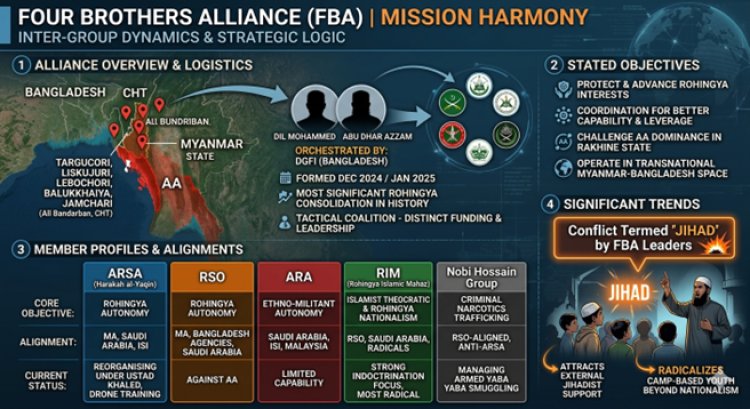
The FBA religious leaders have termed the conflict against the AA as a ‘jihad’, which is significant for its potential to attract external jihadist support and to radicalise camp-based youth beyond the immediate political objectives of Rohingya nationalism.
Foreign Actors
Pakistan: Strategic Calculus of ISI
ISI of Pakistan has emerged as the most significant external state actor in the CHT-Rakhine corridor since the 2024 Bangladesh transition. The past ISI doctrine of a destabilised Bangladesh wracked by radicals, communal conflict and political instability diverts India’s strategic focus and resources from Pakistan's frontiers. This also paves the way for global terrorist organisations to attempt an expansion into East and North-East India. The western and northern frontiers create operational opportunities for Al-Qaeda and affiliated networks to penetrate the eastern flank of the Indian subcontinent. This dynamic also offers the Inter-Services Intelligence (ISI) significant leverage over the comprehensive security framework of northeastern India.
Saudi Arabia: Finances & Ideology
The role of Saudi Arabia in the CHT-Rakhine extremist ecosystem is two-tracked: financial support through diaspora and charitable organisations, and transfer of radical extremist ideology. ARSA's founder, Ataullah Abu Ammar Jununi, operated from Saudi Arabia until his arrest in March 2025. The radical religious establishments in Saudi Arabia have framed the Rohingya issue as an anti-Muslim campaign, aiding recruitment and radicalisation.
Turkiye: Diplomatic and Resource Assistance
The involvement of Turkiye in the Rohingya crisis has been humanitarian diplomacy and material support to the Rohingya organisations. Turkish humanitarian agencies have extensively operated in Cox's Bazar, and the Turkish government has raised the Rohingya issue in international forums. Several intelligence reports suggest that Turkiye is linked to the financial and logistics networks of ARSA, RSO, and ARA. The strategy employed by Turkiye appears to aim at establishing itself as a prominent soft power within Muslim-majority nations while simultaneously facilitating a channel for resource support to extremist organizations.
Malaysia: Transit Centre
Malaysia functions as an important transit node both financially and logistically, owing to the presence of a large Rohingya diaspora (an estimated 1,00,000), which leverages less restrictive monitoring of informal financial flows. Reports have indicated that Malaysia is being used as a transit route for terrorists and for the movement of materials from the Middle East to the Bangladesh-Myanmar border region.
China: Playing Safe for Risk Mitigation
The role of China in the CHT-Rakhine corridor is characterised by maintaining economic and infrastructure investments in both Myanmar and Bangladesh. China has maintained engagement with the AA as the de facto governing power in Rakhine and simultaneously provided the MA with military hardware and diplomatic cover at the United Nations.
Bangladesh: Role of State Actors
DGFI, reportedly orchestrating the FBA/ Mission Harmony coalition agreement amongst the Rohingya in November 2024, helped in the consolidation of the Rohingya under the Bangladesh Army. The appointment of Ustad Khaled as ARSA chief, following Ataullah's arrest, is allegedly a DGFI-managed asset, with security implications not only in Rakhine but across the entire region.
Implications for India: Eastern Frontier
Status of India-Bangladesh Security Partnership
There has been a transition in Indo-Bangladesh bilateral security partnerships post-October 2024, before which the Bangladesh government maintained close counter-terrorism cooperation with India. This transition has created a strategic void that other actors, particularly the ISI, are smartly moving into. India-Bangladesh relations are now marked by border tension, and anti-India statements by government officials and political actors have indicated a hostile attitude towards Indian interests.
Strategic Threat
- Kaladan Multi-Modal Transit Transport Project - The project connects Kolkata to the Sittwe Port, Rakhine and then to Mizoram. Increased conflict among MA, AA, and radical groups in the Rakhine-Chittagong passage can further delay the strategic connectivity project.
- Chicken Neck Vulnerability - The Chicken’s neck strip (Siliguri Corridor) is just 22 km wide, connecting the northeastern states to the rest of India. Due to its strategic importance, it is always a threatened area, and external actors can subsequently leverage the consolidation of radical groups to create security threat.
Radicalization & Spillover Radical Extremism
- Recruitment & Reactivation of Modules - Reportedly, the radical ideology originating from the Rakhine-CHT area strip is being used to radicalize pockets in West Bengal and Assam. The vulnerable nodes along the Indo-Bangladesh border with the Salafi network can reactivate terror modules in the hinterland.
- Rohingya Groups Spillover - Mission Harmony/ FBA, a coalition of Rohingya armed groups, if it stabilises and develops operational capability, can have a direct bearing on the North-Eastern States. The ethnic linkages between the CHT and the Indian side will provide natural cover for infiltration and exfiltration of armed cadres.
- Digital Radicalisation - The exponential increase in digital subscriptions of radicalisation content, primarily of ISIS and AQIS, are being equally accessed by Indian youths in Eastern border areas, as Rohingya groups and physical proximity can manifest the digital radicalisation into visible actions.
Demographic Aspects
- Ethnic & Linguistic Connection - The demography along the Rakhine-CHT passage and the Indian states have similarities, or they are ethnically the same group, leading to human cover for the population infiltrating into the Indian side.
- Rohingyas - The past trends have suggested radicalised Rohingyas from Refugee camps have infiltrated into India, creating a long-term internal security challenge. In addition, the Rohingyas are highly susceptible to recruitment by pan-Islamic terror modules operating in India.
- Safe Havens: The demography and terrain of the CHT area provide a safe haven to the Indian Insurgent Groups, also.
Border Security: Terror-Crime Connection
- Proliferation of Small Arms - ARSA and RSO utilise the same smuggling routes as Indian insurgent groups, and this conflict in the CHT-Rakhine area acts as an open market for weapons, with weapons also flowing into the Indian side.
- Narcotics - There are clear indicators of linkage between radicalization in the Rakhine-CHT strip and the surge in Yaba (methamphetamine) smuggling into India. Profits from the drug trade are increasingly used to finance the procurement of IEDs and the latest technology for radical groups, directly impacting the youth in the Region.
Direct Threat Vectors to India
- Proximity of Radical Groups Training Camp - The establishment of JAFHS and other radical groups' training camps in Bandarban District, CHT, has a close geographical proximity to the Indian border, implying a direct threat to the Indian border.
- Revival in Northeast Region: Insurgency & Radicalisation - The open statement by Mufti Jasimuddin Rahmani, ideological chief of AAI, immediately upon his release in August 2024, for the revival of separatist movements in Kashmir and India's Northeast represent an explicit AQIS strategic intent to exploit regional instability. In addition to this, the instability also provides way to Indian insurgent groups to regain access in CHT and attempt its reactivation.
The convergence of a post-transition security vacuum in Bangladesh, consolidation of Rohingya armed groups under Mission Harmony, expansion of Al-Qaeda-linked networks into institutional and digital spaces, the resurgence of JAFHS and other radical extremist groups in the CHT hills proximate to the Indian border and attempts of ISI have created a threat environment of complexity and urgency. The CHT-Rakhine corridor is no longer just a humanitarian concern or a border management challenge; it has become the node of a transnational security crisis involving state sponsors such as Pakistan, a turmoiled state; Myanmar, a politically transitioning state; Bangladesh, a vast displaced Rohingya and neo-fundamentalist global terror outfits, all next to the most geopolitically sensitive region of India.
India must respond in a manner proportional to the scale and complexity of the existing threat. This requires a comprehensive, multi-domain strategic framework that integrates physical security along the border, proactive intelligence, diplomatic engagement, financial counter-measures, and sustained counter-radicalisation efforts.
Disclaimer: This paper is the author's individual scholastic contribution and does not necessarily reflect the organization's viewpoint.
Lt Col Ujjual Abhishek Jha (Retd) is an Intelligence veteran and Geopolitical Risk Analyst with over two decades of experience in Military Intelligence and National Security operations across sensitive theatres of the North East, Punjab and Gujarat borders.