India’s Transnational Security Challenges: Cross-border Terrorism, Human Trafficking, Asymmetric and Hybrid Warfare
 usanasfoundation
Research Essay
By Aishwarya Das Pattnaik
Introduction
“The state-on-state conflicts of the 20th Century are being replaced by Hybrid Wars and asymmetric contests in which there is no clear-cut distinction between soldiers and civilians and between organised violence, terror, crime, and war.” - Alan Dupont
Modern-day conflict spans a wide and interconnected spectrum, encompassing traditional warfare, including threats from nuclear-armed rivals, as well as cyber operations, space-based confrontations, economic coercion, and the deployment of non-state actors such as terrorists, militants, insurgents, and religious extremists. It's not merely that traditional interstate or conventional warfare is diminishing; rather, there's an emerging fusion of conflict forms that increasingly blurs the lines between regular and irregular warfare. Today’s wars, as noted sharply by Frank G. Hoffman, are shaped by intelligence that is widely known as ‘shadow wars’, hybrid wars, or proxy wars involving non-state actors in both conventional and unconventional irregular manner. According to the United Kingdom's hybrid warfare doctrine, such conflicts are often driven by irregular groups equipped with advanced weaponry and technology typically associated with formal militaries. These campaigns are highly adaptive, shifting tactics and tools based on available resources and the changing operational environment.
These terms are not exclusive to any single framework. A range of overlapping concepts, such as grey zone threats, grey area warfare, compound warfare, informational operations, unconventional and irregular warfare, cognitive warfare, and liminal warfare, populate and often compete within this increasingly complex and densely defined conceptual landscape. In the same vein, India's security landscape has transformed due to the increasing prominence of transnational terrorism and long-time contestation over the illegal occupation of Jammu & Kashmir, predominantly allegedly sponsored by Pakistan against the Indian state since 1947. This challenge now intersects with hybrid warfare tactics such as digital misinformation, ideological manipulation, and cyber operations, deployed across borders, whilst necessitating immediate policy intervention from regional, national, nuanced, and independent perspectives. These threats have evolved beyond conventional insurgency into complex hybrid warfare, combining guerrilla violence with information and ideological operations. As noted by Tariq Mir, a Pakistani Pulitzer prize winner notes that attacks by jihadist backed proxies demonstrate hallmark features of this violence, these include violence in the vernacular such as the slow erasure of Kashmir’s 700 year old tradition of Kashmiri Pandits, Shiviates and Sufi Islam heritage due to rise in faith-based violent terror forms of radicalisation such as Jihadist Salafism and Deobandi sects in Jammu & Kashmir, India.
Ethnic targeting of non-Muslims resulting in large-scale civilian casualties across faith-groups, and cross-border planning as explained by Mumtaz Ahmad, who highlights that radical extremist groups comprise landless peasants and low-income families in Azad Kashmir, illegally occupied and annexed by Pakistan and backed by Pakistani military and state policy favouring the privileged, elite feudal majoritarian capture.
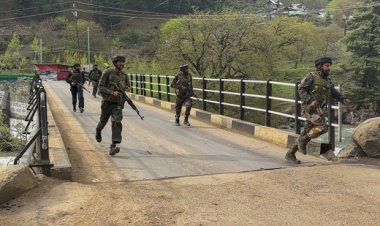
Notable examples include the faith-based ethnic exodus and genocide of Kashmir’s Pandits in 1989–90, the 2001 Indian parliament attack, the 2008 Mumbai (26/11) attacks, and the April 2025 Pahalgam massacre of tourists. Each of these highlighted Pakistan’s role in supporting militant groups such as Lashkar-e-Taiba, Jaish-e-Mohammed, and newer fronts like the “Resistance Front,” which has been accused by the Indian government of being an offshoot of LeT, and the significant impact on the Indian pluralistic society, politics, and the Indian spirit. In the aftermath, India’s foreign minister unequivocally laid the blame on Pakistan’s continued support of these militants. For example, New Delhi suspended the Indus Waters Treaty – a remarkable diplomatic retaliation – “until Pakistan credibly and irrevocably abjures its support for cross-border terrorism”. The Pahalgam massacre showed a disturbing pattern where heavily armed attackers, coming from across the border, launched a violent strike deep within Indian territory. This time, however, the attackers specifically targeted tourists, highlighting their readiness to harm innocent people to provoke anger and fear.
Notably, the attack drew broad domestic condemnation with some pro-peace and democracy rallies by Indians from the Kashmiri Muslim communities (a majority in Kashmir), Muslim-Hindu peace rallies, and independent journalistic body reportage on it, a sign of an axis of resistance towards criminal forms of violent extremism. In true Sufi Islam spirit, roads were filled with candlelit marches, while women and girl students led marches condemning the faith-based terror attacks. Kashmiri youth who aspire for opportunities but are held back due to viciously entrenched religious and social norms, including patriarchy. Meanwhile, many surrendered ex-terrorists, who are the ‘real voice of the underbelly' and speak in the vernacular, often remain marginalised. These populations are largely neglected by Western mainstream media and academia, which often fails to recognise the significant shifts in social and behavioural attitudes within Kashmir since the insurgency began in 1989, a prolonged conflict that has cost thousands of innocent civilians' lives. Their voices need to be heard.
As Pradeep Semwal majestically posits, over the past three decades, Operation TOPAC has exemplified Pakistan's long hybrid warfare approach, designed to systematically weaken India through a strategy often described as "bleeding with a thousand cuts."
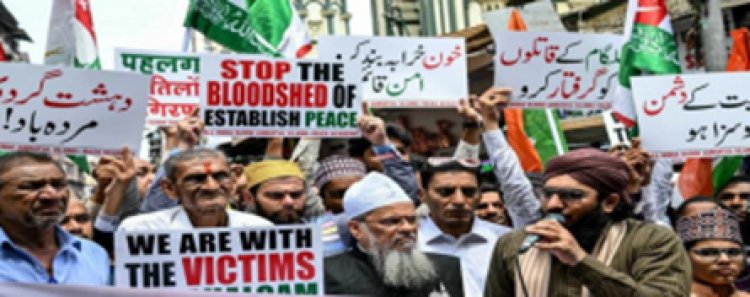

Figure 1: In Mumbai, Hindus and Muslims jointly protest the April 2025 Pahalgam attack and Kashmiri Muslim women and girl students' peace rallies condemning the terrorist attack by Pakistan proxy wars on Jammu and Kashmir, India. Photo shows citizens of different faiths holding placards “Stop the Bloodshed…Establish Peace” and “We are with the victims” (Miller, 2025). This cross-community solidarity belies extremists’ hopes of igniting Hindu-Muslim conflict.
Hybrid Warfare: Policy Implications of Misinformation, Ideological Conflict, and Cyber Threats on regional peace and stability in South Asia
Beyond physical transnational terror attacks, India now confronts a hybrid warfare campaign combining ideological warfare, narrative/informational warfare, and cyber operations (Awasthi, 2025). Pakistan’s strategic doctrine explicitly endorses such sub-conventional means. A recent study in the CLAWS Journal details that Pakistan’s military and ISI see “jihad” as a national policy and duty, encouraging irregular warfare against non-Muslim (Indian) and Muslims who are secular as adversaries. Its interpretation of the “Concept of War” doctrine espouses jihad as a perpetual struggle, legitimizing terrorism as state policy. Further, hybrid warfare is “conceptualised…as a tool of state policy and…a force multiplier to exploit the strategic divide between India and Pakistan.” Notable Pakistani scholars have identified the primary objectives of the Pakistani military, dynastic political families and other political regimes. These objectives include undermining Indian military advantage via plausible deniability, “to further divide and create mistrust between the Kashmiris and the Indian government” through sensational attack, and creating circumstances in the valley to attract international attention regarding the sovereignty of India over the state of Jammu & Kashmir in India, an issue prominently highlighted by key Pakistani state ambassadors. In short, Pakistan pursues a multi-pronged hybrid campaign that manifests into violent terror, ideological indoctrination, and information operations.
For instance, in practice, this hybrid front showed up in India following the 2025 Pahalgam terror attack, Indian civil authorities identified a surge of disinformation campaigns originating from Pakistan and China. These campaigns disseminated fabricated narratives such as false reports of Indian military setbacks and doctored AI combat footage and pictures to undermine public trust and incite communal tensions within the country. The Press Information Bureau (PIB) debunked these falsehoods, highlighting them as coordinated efforts to destabilise security through hybrid information warfare by weaponising narratives. Pakistan’s state policy of sheltering and sponsoring terrorists under the pretext of minority rights and so-called “self-determination” in Kashmir complicates bilateral engagement with India. These actions deflect attention from Pakistan’s internal challenges in Balochistan and Khyber Pakhtunkhwa, including democratic erosion, economic instability, deteriorating gender inequality, and independent media repression. Concurrently, India faces criticism from commentators over communal violence and caste-based discrimination. However, recent legislation aims to safeguard minority rights within India's pluralistic framework. The legacy of Pakistan’s militarised response to the loss of East Pakistan (now independent Bangladesh) continues to shape its ideological hostility toward India, often exploiting international forums to further its anti-India narratives. This dichotomy is further exploited by external actors; for instance, extreme Islamist outlets emphasise narratives of Hindu communal violence to portray India as intolerant towards Muslims, while nationalist elements accuse critics of being lenient on terrorism, and some Hindus feel they are under threat. Reasons for collective healing and generational social injustices need to be addressed politically and socially. Such dynamics create a fertile ground for foreign influence campaigns, with reports suggesting that Pakistani entities amplify polarizing content to exacerbate Hindu-Muslim tensions in India.
Finally, electronic and cyber warfare are emerging concerns. While India’s chief adversary remains Pakistan, China also looms in the cyber-sphere as it has a long history of hacking attempts on critical Indian infrastructure, human rights activists, and particularly government organisations, among others.
India has begun strengthening cyber defences, establishing agencies, and drafting bills on digital security. But much work remains, as recent incidents of alleged state-sponsorship of disinformation from border countries, use of deepfakes, misuse of encrypted communications, and even drone incursions by militants show that hybrid means are truly multi-dimensional. In response, India has started to cooperate with tech firms and international partners, seeking to develop counter-tools.
Illegal Migration, Radicalization, and Political Mobilization
Illegal migration has become deeply intertwined with India’s national security and political landscape. India’s porous borders with Bangladesh, Myanmar, and Pakistan facilitate unauthorized movements that are occasionally exploited by extremist jihadist groups, undermining security in Bangladesh and India. A notable case involves the Rohingya refugee population. Investigations reveal that Pakistan-linked jihadist organizations such as Lashkar-e-Taiba and Jaish-e-Mohammed have recruited disenfranchised Rohingyas into militant ranks. Entities like Aqa Mul Mujahideen, reportedly tied to Hafiz Saeed, have operated alongside Pakistani extremists in Kashmir, with confirmed casualties of Rohingya fighters. Additionally, Indian authorities periodically disrupt terror-linked sleeper cells in refugee settlements across Jammu and Assam. Beyond security risks, illegal migration has emerged as a political flashpoint. The Citizenship Amendment Act (2019) and NRC have been defended as tools against infiltration, while critics argue they marginalise vulnerable Muslim minorities for electoral gains. Simultaneously, adversaries such as Pakistan weaponise India’s policies in international propaganda, highlighting a dual-use threat of radicalisation and political destabilisation.
Winners and Losers: Costs of Violence and Reactions
The consequences of Pakistan-sponsored terror and hybrid warfare cut across societies. Who gains? On the surface, militant groups score propaganda victories: an attack like Pahalgam generates global headlines and forces India’s hand, which these groups claim as proof of “resistance.” Pakistan’s military establishment benefits from these disruptions, too. Analysts contend that heightened tensions within Pakistan's domestic or diplomatic landscape, such as those arising from the increasing freedom movement in Balochistan, Khyber Pakhtunkhwa, and issues along the western border, can lead to acts of terrorism. These incidents may serve to redirect public attention towards external threats and consolidate nationalist sentiment domestically (Miller, 2025; Shaikh, 2024). Indeed, critics speculate that Pakistan’s military may spur Kashmir attacks to leverage times when it feels “excluded from geopolitical conversations,” such as around major foreign visits.
Tackling Transnational State-Sponsored Hybrid Warfare: Causal Impacts and Strategic Dilemmas for Decision-Makers
Pakistan’s sponsorship of terrorism and hybrid warfare against India, including militant attacks, disinformation, and psychological operations, produces complex, asymmetric impacts that transcend borders. These actions are often calibrated to exploit geopolitical volatility, with attacks like the 2025 Pahalgam incident designed to provoke both symbolic and strategic responses. Such violence not only serves Pakistan's internal political objectives, as analysed by the Council on Foreign Relations (2024), but also reinforces militant legitimacy through performative resistance narratives. Domestically, these incidents bolster India's ruling leadership, embolden nationalist rhetoric, and catalyse defence procurement, though often at the cost of civil liberties and minority rights. However, the costs are diffuse and enduring. Civilians, especially in conflict-affected border zones, are immediate victims. Muslims in India, particularly in Kashmir, experience heightened surveillance, communal backlash, and civil rights erosion. Repeated lockdowns and curfews destabilise economic life and deepen alienation. Kashmir Pandits remain displaced, unable to return amid persistent security threats.
At the international level, Pakistan’s duplicity continues to erode its credibility, yet its protection under China’s UNSC veto and strategic hedging by the United States obstructs meaningful accountability. India must seize the opportunity to lead cyber-norm reforms and build transnational coalitions against hybrid aggression. Failure to do so risks normalising extremist proxy warfare and weakening global counterterrorism norms. At the state level, the counter-hybrid strategy includes expanded digital censorship powers, however an ‘Integrated Deterrence Strategy' should incorporate an Intermediate Force Capabilities (IFC) that uses below lethal intent to temporarily impair, delay across all domains of competition and conflict, while addressing violent extremist terror attacks on civilians or insurgencies. However, right-wing factions exploit crises to advance exclusionary legislation, straining India’s secularism. Meanwhile, conventional deterrence strategies have become inadequate in responding to 21st-century hybrid threats involving both state and non-state actors and oscillating between stability and instability.
Conclusion: A Holistic Policy Vision for India’s Fight Against Transnational Terrorism and Hybrid Threats
India’s struggle against transnational terrorism and hybrid warfare requires a multi-dimensional and “all of a nation” policy response. Ground realities – from the hills of Kashmir to the pixels of social media – demand coordinated action. Domestically, India must bolster intelligence and border security (to detect infiltrators), while also investing in socio-economic development in vulnerable regions (to undercut grievances). Countering hybrid threats means enhancing cyber-capabilities: monitoring and removing online propaganda, training law enforcement in digital forensics, and working with tech companies to flag extremist content.
Politically, India must balance unity with inclusivity. Hardline rhetoric can rally support in the short term, but real victory against insurgency requires winning hearts and minds. Ensuring that Kashmiri civilians (and Indian Muslims elsewhere) feel protected by the state – not persecuted for militants’ crimes – is crucial. India can expand rehabilitation of Kashmiri Pandits, rebuild destroyed villages, and incorporate Kashmiri local leaders, especially women and faith leaders, into dialogue. At the same time, staying vigilant against communal hate is needed; sections of the media and social networks should be held accountable for incitement under the law. Education and civil society programs promoting interfaith understanding could preempt extremist narratives.
On the hybrid front, India should institutionalize counter-disinformation efforts. The Press Information Bureau’s fact-check unit showed the value of rapid response to fake new. This could be scaled into a broader centre for strategic communications (akin to Western fact-check coalitions). India’s legal framework – such as the 2021 IT Rules – already pressurizes platforms, but clear “red lines” against terrorist content and hate speech must be enforced consistently. Partnering with allies (as already begun with Israel and France) on cyber intelligence and AI tools can pay dividends. India might adopt France’s model of empowering courts to act on disinformation (as Paris did in 2018) while safeguarding democratic debate.
Internationally, India should continue deepening strategic partnerships. Its appeals to the UN must be accompanied by coalition-building. At the UN, New Delhi can push for giving observer status to global victims’ groups to keep public focus on terrorism. It can also tie aid and trade negotiations to Pakistan’s terrorism record, as seen in the Indus Treaty suspension. While full UN reform is unlikely, India should use its G20, BRICS, and G4 (India, Germany, Japan, Brazil) groups, among others, to address regional security concerns and the peace process in Jammu and Kashmir, India. India’s growing strategic defence and security agreements with the UK, Australia, Singapore, the USA, Saudi Arabia, and other African countries can still influence peacebuilding and collective healing of all communities affected by terror or militancy with dignity. Notably, the Indian Express diplomatic reporting shows that India won a key semantic battle, which included the UNSC statement that did not allow Pakistan to brand Kashmir as “disputed”– a rare diplomatic success. Such vigilance in wording must continue.
Finally, global lessons stress resilience. India knows that countering hybrid foes is not a one-off task. It requires a ‘whole-of-society' approach, security forces must operate within legal norms, while the media and civil institutions work to inoculate the public against extremist ideology. The Indian state should be iterative in policy; that is, after each attack, it must learn what went wrong (as it did after Mumbai 2008 with coastal security, or after Pulwama 2019 with air response) and adapt accordingly. Continuous funding for counterterror research, independent research, and crisis simulations, like at the National Security Council Secretariat, will keep preparedness high.
In the end, the stakes are clear: the winners of this conflict will shape India’s social fabric and regional order. If hybrid war succeeds in inflaming divisions, communal trust will erode, and extremists will exploit the power vacuum. If India and its partners respond wisely – blending firm security measures with attention to justice and truth – terrorists will lose their fertile narratives and no longer find a haven. The recent attacks are a stern reminder that national security now spans far beyond borders: it is as much about the information we trust and the unity we forge as about guns and walls.
Disclaimer: This paper is the author's individual scholastic contribution and does not necessarily reflect the organization's viewpoint.