Bangladesh’s Radical Shift: The Rise of Islamists, Violent Attacks on Minorities and Anti-India Narratives
 usanasfoundation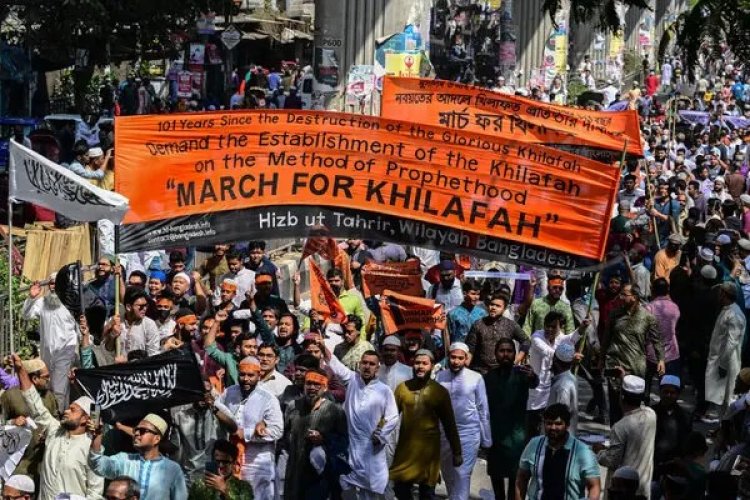
Analysis
By Ruchika Sharma
The horrific killing of Dipu Chandra Das, a Hindu garment factory worker in Bhaluka, Mymensingh, drew attention to the deteriorating security situation in Bangladesh. The systematic targeting of minorities points to a broader and more dangerous pattern unfolding in India’s neighborhood. In the first three days after the fall of Sheikh Hasina’s regime, more than 200 instances targeting minority communities were reported. According to the Bangladesh Hindu Christian Unity Council, 2,010 incidents of attacks were reported between August 4 and 20 in the same year, affecting 1,705 families. Between August and September 2024, 50 cases of forcible conversion to Islam were reported. During the same period, churches and houses of Christians were also reportedly attacked.
The pattern continued in 2025. During the first half of the year, 258 incidents of attacks on minorities were reported. According to Ain o Salish Kendra (ASK), 42 incidents of violence against Hindus were reported. Separate reports further reinforced the scale of violence. At least 71 incidents were linked to blasphemy allegations against Hindus between June and December 2025, reported the Human Rights Congress for Bangladesh Minorities. In the light of rising attacks on minorities, US Congressman Brad Sherman expressed deep concern
and urged Bangladesh’s government to take serious action against the anti-Hindu violence.
Vandalism of Religious Places
The constitution of Bangladesh designates Islam as the state religion but upholds the principle of secularism. However, the religious sites of minorities are subject to frequent attacks. In February 2024, Kuakata municipal authorities initiated the public toilets’ construction on the land of a 240-year-old Buddhist temple belonging to an indigenous Rakhine community, drawing strong objections from the community. In June 2025, a Hindu temple in Dhaka was reportedly demolished as part of an official drive. In another incident in June 2026, a temple of goddess Kali was reportedly vandalised and set ablaze in Pirojpur. The details of the attacks are documented in the Usanas Foundation dossier.
Role of Social Media
Another significant driver contributing to violence is the spreading of false information, including unproven allegations of blasphemy against the minority communities on social media. Accusations leveled on social media against minorities before any formal investigation or verification is launched are one of the significant drivers of violence. In June 2026, shops, temples and houses of the Hindu community were reportedly attacked and vandalised in Sunamganj. The tensions mounted over the allegation against a youth for making objectionable comments about the Prophet Mohammed on Facebook.
In October 2021, communal violence erupted after allegations on social media regarding the desecration of the holy book, the Quran, at a puja pandal during Hindu festival Durga Puja celebrations. Due to the widespread unrest, mobile internet services were shut down. The anti-Hindu violence continued, with at least dozens of temples, houses and shops belonging to the Hindu community reportedly vandalised and set on fire. In another case, an eighth-grade student was reportedly sent to a juvenile detention center. He was allegedly accused of hurting religious sentiments on social media. Amnesty International has warned that Bangladesh could witness further serious human rights abuses unless Meta takes timely and effective measures to curb harmful online content on its Facebook platform. One noticeable thing is that across a majority of these cases, investigations have made little progress, with perpetrators often remaining unidentified or unprosecuted. The absence of effective governance not only undermines people’s confidence in the law but also risks fostering impunity.
ISKCON Controversy and Anti-India Narratives
In 2024, during the arrest of Hindu monk Chinmoy Krishna Das, several Islamist groups intensified their campaign against ISKCON. Mahmudur Rahman, editor of the daily Amar Desh newspaper, demanded an immediate ban on the organisation. Notably, this is not the first time Mahmudur Rahman has made such controversial remarks. According to a 2013 report by Human Rights Watch, Rahman, who served as a former adviser to the BNP government, was arrested and charged with sedition. The report noted that Amar Desh portrayed the activists as atheists following their criticism against the growing influence of fundamentalist Islam. A hit list of secular and atheist bloggers was publicized, while Hefazat-e-Islam supreme leader Shah Ahmed Shafi labeled them as ‘’apostates’’ and declared that killing them was a duty of Muslims.
The demand for an ISKCON ban reverberated across Bangladesh. In a protest rally organized by Hefazat-e-Islam Bangladesh in Chattogram, ISKCON was described as an ‘’anti-Hindu militant group.’’ The hardline Islamist group Hefazat-e-Islam was founded in 2010 in Chittagong. Hefazat-e-Islam emerged in opposition to the Awami League’s 2009 Women Development Policy Draft, which proposed equal inheritance rights for women.
Similarly, leaders of the Anti-Discrimination Students Movement also demanded a ban, alleging that ISKCON was advancing Delhi’s agenda in Bangladesh. Prior to this, Abdul Hannan Masud, the chief organizer, alleged that ISKCON was acting on the instructions of Sheikh Hasina to implement India’s agenda. These developments highlight how the Chinmoy Das episode became a political and ideological issue, with anti-ISCKON rhetoric intersecting with anti-India narratives accelerated by Islamists.
Protest Against Lord Ram’s Statue
Recently, the construction of a Lord Ram statue at the Sri Sri Govinda and Kali Mandir in Palashbari upazila (sub-district) of Gaibandha stirred a massive controversy in Bangladesh. Amid heightened tensions and protests, the temple committee announced the suspension of the idol’s construction. The first prominent public demand against the idol came when the leader of the Insaf Kayemkari Chhatra Sramik Janata organisation called for the demolition of the idol.
Similar demands were also raised by the Imam Ulema Council, which formed a human chain on the Dhaka-Rangpur highway. At a press conference, the leaders of the council demanded a complete ban on idol construction and the cancellation of all related activities. As part of its eight demands, the council urged investigation of the source of funding; the involvement of local and foreign people or organizations; the investigation and auditing of the bank accounts; and an intelligence agency inquiry to investigate whether any foreign state, agency, or person has direct or indirect influence or financial involvement.
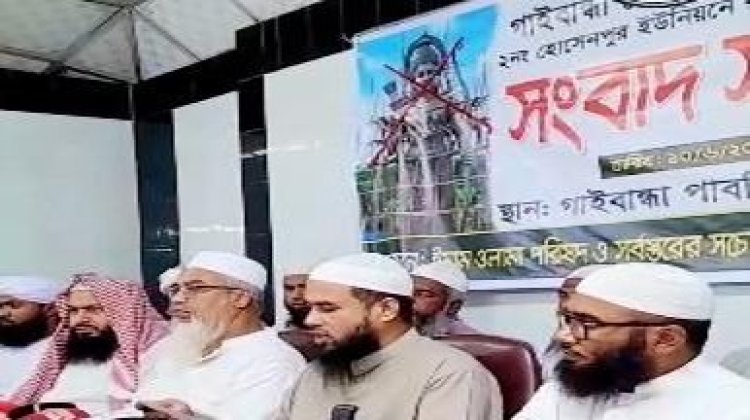
Image: Press Conference demanding the removal of Lord Ram’s Statue/Facebook
Additionally, they expressed concern regarding potential risks to Bangladesh’s sovereignty, national security, social stability and communal harmony and demanded legal action against anyone found involved in the wrongdoings. The issue continued to intensify, according to bdnews24, the speakers warned of launching a strong movement. Those attendees included Upazila President Maulana Sadequl Islam, Secretary Rafiqul Islam, Hefazat-e-Islami Bangladesh Upazila unit President Maulana Shah Alam Faizi, Jamaat leader and former vice-chairman Abu Taleb Master, and Jamaat-e-Islami leaders Principal Golam Mostafa and Khairul Islam. Earlier, the organisation had also submitted a memorandum to the Prime Minister, indicating that the project has evolved into a coordinated campaign.
Among the most vocal critics was Ataur Rahman Bikrompuri. He is famously known for his controversial and hate-filled sermons and provocative online speeches as well as Facebook posts. He strongly opposed the construction of Lord Ram’s idol. He frequently shares images of a proposed “Babri Masjid-Uttar Banga” in Palashbari on Facebook. According to his posts, the proposed mosque would cover nearly 15 acres. He claimed to have initiated the project and was actively involved in collecting public donations for its construction. In addition, he has created a separate Facebook page named “Babri Masjid Uttar Banga” to promote this project.
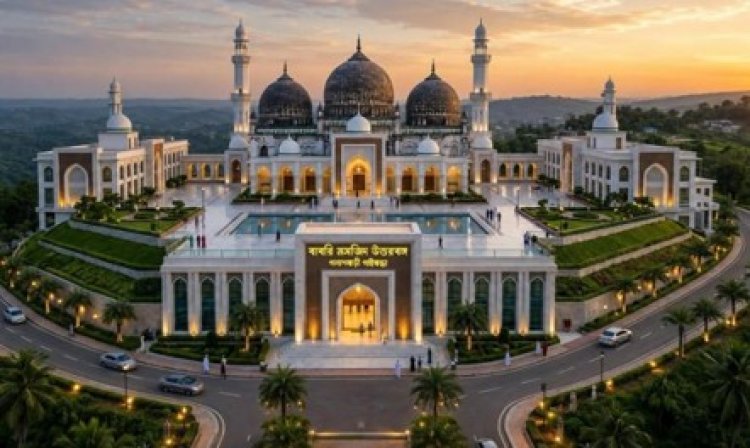
Source: The proposed Babri Masjid Uttarbanga project/Facebook
His fundraising appeals framed the proposed mosque project even in strategic terms. While encouraging donations by describing it as a religious obligation and a form of Sadaqah Jariyah (continuous charity), the posts characterized the mosque as an ‘’anti-dominating fort’’ against India. He further claimed that Muslim villages would be established across large parts of North Bengal centered around the mosque to prevent alleged ‘’Indian aggression.’’ The mosque would serve as ‘’one of the guardians of the geographical integrity of anti-Indian supremacy and beloved motherland Bangladesh.’’
Through a series of Facebook posts, Bikrompuri has frequently expressed strong criticism of India, describing Hindus as militants. He portrayed the construction in Palashbari, Gaibandha, not merely as a religious act but as a part of a broader political agenda associated with the concept of “Akhand Bharat” (undivided India). In a separate post, Bikrompuri alleged that Ram idol’s construction represented the introduction of a foreign political idea into a strategically sensitive region near the Siliguri Corridor and the Tin Bigha Corridor.
Bikrompuri was arrested in 2021 for his alleged links to the Ansarullah Bangla Team, which is linked to Al-Qaeda in the Indian Subcontinent. He has also reportedly played a prominent role in mobilizing protests under the banner of Tawhidi Janata. In one of his online posts he allegedly called for the killing of individuals labeled as ‘’Shatim-e-Rasul’’ (those who are accused of insulting the Prophet). Reports further claim that he frequently describes Muslims who support democratic systems as ‘’kafirs.’’ He also described the Islamic State as ‘’khariji’’ while publicly framing Al-Qaeda and the Taliban as legitimate groups, reflecting his ideological positioning.
Beyond online campaigning, on 7 June, Bikrompuri joined a march alongside Jashimuddin Rahmani, the leader of Ansarullah Bangla Team (linked to Al-Qaeda in the Indian Subcontinent). During the march, the temple renovation project was framed as a national security threat, and they demanded the demolition of the idol, alleging that the project received illicit foreign funding. Citing Hindu organizations and local observers, the report noted that the activists affiliated with Islami Chhatra Shibir and Hefazat-e-Islam played leading roles in the protests. Several protests under the broader banner of “Gaibandha-Palashbari’s General Public” took place, rather than openly identifying with Jamaat-e-Islami or Hefazat-e-Islam.
Opposition also extended beyond Lord Ram’s statue. In a separate incident, a protest rally was organized by the Khelafat Movement in June against the construction of a Lord Shiva temple and Shiva statue in Gaibandha. The construction of Lord Ram’s statue is intertwined with anti-India narratives. In a separate post by Mohammad Anisur Rahman, it was claimed that 900 acres of land in Mirsarai, Chattogram, had been allocated to the Adani Group, describing the development as a serious threat to Bangladesh's national interests. The post quoted retired military officer Major Mohammad Mostafa, who reportedly argued that Bangladesh had little to gain from the project while India would derive strategic benefits by improving access to its northeastern ‘’Seven Sisters’’ region. Anisur Rahman also shared a video, in which protestors were rallying against the construction of the proposed Lord Ram idol. Protesters carried banners, while several participants were seen holding footwear in their hands. In another image, protestors were seen hitting an image of the Lord Ram’s statue on the banner with their footwear.
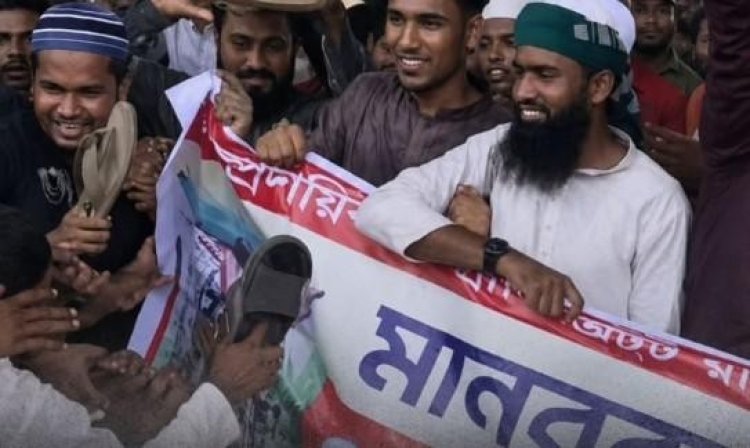
Image: Demonstrations against the construction of Lord Ram’s Stute/HinduVoice
Similarly, security-centric arguments are increasingly put forward in Bangladesh. Maulana Ammarul Haque criticized the construction of idols and argued that the highest priority should be given to establishing specialized military bases and strengthening defense capabilities in the Rangpur and Chittagong divisions. According to a joint media statement published on Hefazat-e-Islam Bangladesh's Facebook page, the organization asserted that the government should thoroughly review proposals for the construction of large-scale Hindu religious establishments in strategically and geographically important locations, including Palashbari.
Attacks on Minorities in Bangladesh
The attack on minorities is not a recent phenomenon. It is not confined to any single political regime. According to the 1951 census of East Pakistan, Hindus constituted 22% of the population. After the liberation of Bangladesh in 1971, the population of Hindus accounted for 13.4% of the population in 1974. Today, Hindus account for less than 8% of the population.
The cycle of violence did not come to a halt even during the Awami League’s rule. According to the Ain o Salish Kendra report, there were 3,710 attacks against the Hindu community between 2013 and 2021. The scale of attacks on minorities, calls for Khilafah and the rise of Islamist elements in Bangladesh with the calls of sharia reveal the erosion of democratic values, religious pluralism and social cohesion. Multiple reports reveal the violence against religious minorities in Bangladesh has existed across successive governments.
In 2015, 262 incidents of persecution against religious minorities were recorded, affecting 1,562 families. Amnesty International’s 2016 report strongly condemned the attacks on Hindu homes, businesses and temples in the Brahmanbaria district of Bangladesh by angry mobs on 30 October 2016. According to media reports, hundreds of people, allegedly linked with the groups Hefazat-e Islam and Ahle Sunnat Wal Jamaat, protested against a social media post that allegedly “insulted Islam.’’ The controversy centered on a local Hindu man who reportedly shared a picture of Masjid al-Haram, the holy site, with the Hindu god Shiva edited on the Kaaba. The 2021 Amnesty International report expressed concerns against violent attacks on Hindu minority houses and temples in Bangladesh. Saad Hammadi, Amnesty International’s South Asia campaigner, stated, “the spate of attacks by angry mobs during the country’s biggest Hindu festival was symptomatic of growing anti-minority sentiment’’. He added that the repeated incidents of communal violence and destruction of the homes and places of worship of minorities in Bangladesh over the years reflected the state’s failure to safeguard its minorities.
Violent attacks are not limited to Hindus alone. In 2024, Tripura Para, a Christian village, witnessed a serious incident. 17 of the village’s 19 houses were set ablaze by the unidentified miscreants while residents had gone to another village for prayers and Christmas celebrations since there was no church in their area. Those responsible for this incident reportedly remained unidentified and had not been arrested.
The Human Rights Congress for Bangladesh Minorities (HRCBM) released a report titled The Persecution Continues: Minority Communities Under Sustained Attack in Bangladesh, documenting events from January to April 2026. The report recorded 505 incidents across 62 districts and all 8 divisions of Bangladesh.
Importantly, concerns regarding the state's inability to protect minorities are not new. A 2001 Amnesty International report similarly criticised successive Bangladeshi governments for failing to safeguard minority communities during periods of political instability. After the October 2001 general elections, a coalition led by the Bangladesh Nationalist Party (BNP) secured victory. Hindus were reportedly attacked by BNP supporters because of their perceived support for the rival Awami League party. Hundreds of Hindu families were reportedly driven from their land. Groups affiliated with the BNP-led coalition allegedly burnt homes and raped Hindu women. In the same year, several Hindu families were reportedly evicted from their lands by groups linked to the Bangladesh National Party and Jamaat-e-Islami.
Developments in Bangladesh
The rise in anti-India sentiments is increasingly worrying for India. The demand for a Taliban-style emirate by the Islamists points towards the erosion of democracy and tolerance for diversity. It reflects a deeper ideological recalibration of the Bangladeshi state. This can be traced to when the calls for the removal of foundational constitutional principles such as secularism, socialism, and nationalism were raised. The normalization of extremist symbols in public processions and the resurgence of radicals post-August 2024 is enabling grassroots radicalization powered by extremism. In one of the videos shared by Ataur Rahman Bikrompuri, an individual asserts that Hindus from India favour Israel and extend their open support to Israelis, with leaders in responsible positions also endorsing Israel. He further claimed that Hindu leaders have shown keen interest in Israel and in controlling Muslim populations. He further described Hindus in India as well as Bangladesh as militants and added that they express happiness when Israel kills Muslims. Lastly, he questions why Muslims can’t stand in favor of Hamas?
Surge in Kalema Flags
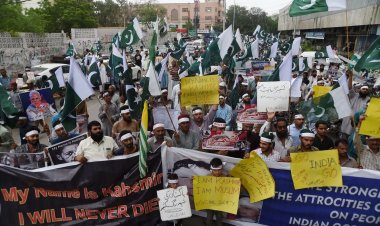
There has been a noticeable rise in the display of Kalema-bearing flags during rallies and protests, including pro-Palestine demonstrations. Provocative figures such as Ataur Rahman Bikrompuri have publicly defended the use of such symbols, arguing that they are lawful under Bangladeshi legislation while warning authorities against restricting them. He asserted that the flag is not illegal under Bangladeshi law. In a separate post, the issuance of a show-cause notice at Jahangirnagar University for raising the Kalema flag prompted the question: “Is this a Muslim country?” His post warned that if such actions remain unchecked, a time will come when even identifying oneself as a Muslim would no longer be possible. Social media activities linked to Bikrompuri’s Azadi Andolon Bangladesh further reinforce this narrative ecosystem.
Similarly, Mufti Harun Izhar, a senior leader of the radical Islamist group Hefazat-e-Islam, urged supporters to take down the flags of Argentina and Brazil and replace them with white Kalema flags. Harun Izhar is a son of Mufti Izharul Islam, the founder of the radical Islamist group Hefazat-e-Islam. He was reportedly trained in Afghanistan by the bodyguard of al-Qaeda's chief, Osama bin Laden. He was also the former chief of the militant alliance Islami Oikya Jote and Bangladesh Nationalist Party. In 2009, he was arrested for allegedly planning an attack on the US embassy in Dhaka. During the investigation, he revealed that the plan was discussed telephonically by Lashkar-e-Taiba’s leader in Pakistan. Harun Izhar's Facebook posts are often directed against India. An image shared on November 30, 2023, showed a group stepping on Israel's flag. Harun Izhar described the group as ‘’young Hamas.’’ In one of the exclusive interviews, the confirmation of Hamas' presence by Israel in Bangladesh is viewed as a “conspiracy’’.
Sarwar Saimon, describing himself as a politician on X, shared a video in which Bangladeshi flags, Palestinian flags, and white and black flags with Kalema inscriptions were seen in a bike rally, with chants of Takbeer, Allah o Akbar. Several accounts on Facebook are celebrating the installation of Kalema flags in Bangladesh, linking with the strength and unity of Muslim ummah. However, Kazi Shah Mofazzal Houssain, Bangladesh’s Religious Affairs Minister, reportedly warned against political misuse of Kalema flags or other Islamic symbols.
It is important to mention that the domestic developments in India are not overlooked in Bangladesh. Following the West Bengal election results, a rally in Bangladesh targeting Indian Home Minister Amit Shah and West Bengal Chief Minister Suvendu Adhikari was organized.
The nighttime torchlight procession reportedly featured anti-India banners and slogans in the protest organized by the Bangladesh Azad Party against alleged ‘’Indian hegemony.’’ Among those present were President Lt. Col. (Retd.) Hasinur Rahman, Barrister ASM Shahriar Kabir and Rashed Prodhan, spokesperson for the Jatiya Ganatantrik Party, among others.
Addressing the protestors, Rashed Prodhan asserted that anyone who questions Bangladesh's independence, sovereignty, and territorial integrity will face a renewed struggle. The Bangladesh Azad Party was launched on April 20 and aims to establish ‘’a state based on justice and fairness’’ and to build ‘’a Bangladesh free from Indian hegemony.’’
Islamist Resurgence and Transnational Linkages
Open-source materials, including videos and public statements, highlight Bangladesh’s trudging on a dangerous trajectory. The operational space for Islamist organisations such as Hefazat-e-Islam, Towhidi Janata Azadi Andolon Bangladesh and Ansar Bangla Team (ABT) has widened. In another concerning development, the intelligence officials suggest that Hamas is reaching out to the Tawhidi Janata to expand its presence in Bangladesh.
Weaponisation of Martial Arts
On May 4, 2026, a video showed fighters allegedly pledging allegiance to the Islamic State. In a post shared, Sarwar Saimon claimed that under the guise of sports, a shadow network is weaponising martial arts training to radicalise youth for extremist violence. He mentions Fatah Combat System martial arts centers in Khulna, Jessore and Chandpur. This network is allegedly headed by Shah Amanat Sabir, which is claimed to be linked to Afghanistan-returned jihadists, funneling recruits to Tehreek-e-Taliban Pakistan and trying to create Tehreek-e-Taliban Bangladesh. In a separate post, he mentioned that 6 suspects, including the trainer Shah Amanat Sabir, were arrested by Bangladeshi police. As per the website, it is a unique blend of martial arts with Islamic principles. It is a martial arts style free from music, shirk and kufr and includes scenario-based self-defense training. According to The Daily Star, Sabir allegedly established a group named “SBJ” (Sabir Bhaiyer Jama’), comprising around 13-15 members. According to an official, ’Jama’’ was short for ‘jamaat,’ meaning a group. The outfit was reportedly self-styled, and Sabir was known as “amir-e-mujahid.” Reports further indicate that he had initially approached the leadership of banned organizations such as Ansar Al Islam and Harkat-ul-Jihad-al-Islami Bangladesh (Huji-B). However, he eventually chose to form his own group, citing differences in ideology.
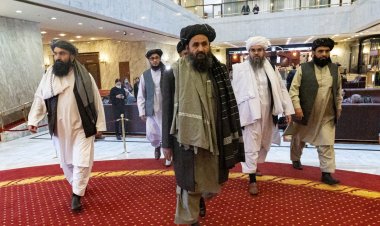
The reports of direct or indirect links between Islamists in Bangladesh and transnational jihadists is another critical development in the terror landscape of South Asia. In December 2025, Mullah Noor Ahmad Noor, a senior Taliban leader and director-general at Kabul’s Ministry of Foreign Affairs, reportedly visited Dhaka. During his visit, he reportedly met local religious leaders and visited Qaumi madrasas. He reportedly met Mamunul Haque, emir of the Islamist party Khelafat-e-Majlis. Notably, Bangladesh’s Counter-terrorism and Transnational Crime unit was reportedly unaware of these visits, raising serious questions about institutional oversight. Individuals linked to banned outfits, including Harkat-ul-Jihad-al-Islami, were present in the meeting. HuJi-B, operating across South Asia, has been designated as a violent extremist organisation by the United Nations.
The Taliban leader has reportedly visited several Qaumi madrassas during his visit to Bangladesh with the help of Sayem Khaled. Reportedly, Abu Sayem Khaled, who is suspected to be the HuJi-B’s emir of Narayanganj’s district, allegedly visited Afghanistan, Dubai, and returned via Pakistan.
The madrassa in Narayanganj has reportedly been visited by several foreign figures, including Pakistan-occupied Kashmir’s Parliament’s secretary Pir Mazhar Saeed Shah. Shah reportedly began his militant journey with Harkat-ul-Mujahideen and later Jaish-e-Mohammad. Shah has also reportedly served with the Afghan Taliban as well. In one of the videos titled Land of Love Bangladesh, Shah visited Dhaka in August 2025, where parallels were drawn between Palestine and Kashmir. The video shows countless men gathered around him, chanting slogans of Nara-e-Takbir, Allah o Akbar, and Tera mera rishta kya La ilaha illa Allah in the background. Photos on Shah’s website show him alongside Jamiat Ulema-e-Islam chief Maulana Fazl ur Rehman. It is worthwhile to mention that JUI-F chief Rahman is at the forefront of hosting Hamas leaders in his rallies and conferences post-October-7 attack.
In September 2025, a delegation led by Bangladesh Khelafat-e-Majlis leader Mamunul Haque visited Kabul and met Taliban leaders. Other members on the delegation included Maulana Abdul Hamid, Pir of Madhupur and Nayeb-e-Amir, Hefazat-e-Islam; Maulana Abdul Awal, Nayeb-e-Amir, Hefazat-e-Islam; Maulana Abdul Haque, Khatib, Mymensingh Bara Masjid; Maulana Habibullah Mahmud Qasemi, Senior Muhaddith, Baridhara Madrasa; Maulana Monir Hossain Qasemi, Jamiat Leader; and Maulana Mahbubur Rahman, Local Scholar, Mymensingh.
Implications for India
The direction of developments in Bangladesh is extremely concerning. India’s eastern frontier is increasingly becoming another hotspot for extremist activities, especially post-August 2024. The current trajectory suggests the widening space for radicals and jihadists in Bangladesh. Statements made by provocative figures are used to shape public sentiment and, in some cases, justify hostility or violence against minorities. For instance, Ataur Rahman Bikrompuri portrayed lord “Ram” as a symbol of terror and framed the “Jai Shri Ram” slogan as violent. Political and media statements along with developments in India are carefully interpreted and weaponized to mobilize support, reinforce grievance politics, and position Islamists as defenders of the Muslim ummah.
The increasing visibility of Kalema flags accompanied by slogans ‘’Tera mera rishta kya La ilaha illa Allah, which means there is no god but Allah (what is the bond between you and me?), criticism of cultural events, sports, and the growing influence of madrasa networks point to a shift in the public and religious sphere. The shrinking space for religious minorities further indicates that these changes are not only rhetorical but also affecting ground realities.
Looking at the developments, Bangladesh is also following in the footsteps of Pakistan, which has historically functioned as a safe haven for several terror groups. Different Jihadist groups may seek to expand their influence, leading to both potential collaboration and exchange of tactics. This could also lead to the expansion of sympathetic or support networks within India, as individuals find it easier to connect with or join transnational extremist ecosystems operating in the region.
Finally, India’s own policy approach deserves scrutiny. Its close engagement with the Awami League government did not translate to strong public responses to issues such as minority persecution. If the developments are left unchecked, these trends could reshape the security landscape in the region, that are detrimental to India’s security landscape.
Note: Translation credits: Maxim Sinha, Research Intern, Usanas Foundation. The audio/video has been translated from Bangla to English. Since Bangla is spoken in several regions in different accents and dialects, including Sylheti and Dhakaiya, slight differences in wording, pronunciation and meaning may occur during translation.
Disclaimer: This paper is the author's individual scholastic contribution and does not necessarily reflect the organization's viewpoint.