Russia After Assad: Recalibrating Power Across West Asia
 usanasfoundation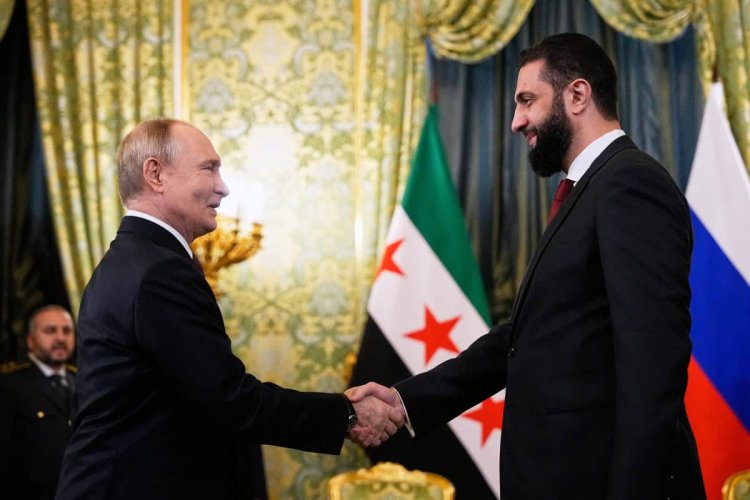
Analysis
By Neelashma Jain
The fall of Bashar al- Assad’s regime in December 2024 signalled a major shift in Russia’s approach towards West Asia. For nearly a decade, Russia had focused its regional strategy on protecting Assad, maintaining Hmeimim airbase and the Tartus naval facility, and positioning Assad’s government as a key actor for its influence in the region. The collapse of the regime led to Assad fleeing to Moscow; it was a setback to their influence in the region and led to a recalibration of their strategy towards West Asia.
Instead of retreating, Russia began adapting and restructuring its position, with military equipment and personnel being moved from bases in Syria to Libya, where Russia operated a few facilities. Relations were established with the new transitional government in Damascus, headed by Ahmed al-Sharaa, with him visiting the Kremlin twice. Negotiations with Libya’s Khalifa Haftar for expanded access to their Tobruk port and airbase took place. They also signed the Iranian–Russian Treaty on Comprehensive Strategic Partnership in January 2025.
The fall of Assad sped up a diversification in strategy that had already been a work in progress. It has shifted from unconditional backing of a single regime to a more dispersed network of military, economic and diplomatic relations spanning Syria, Libya, Iran, and the Gulf states. Russia’s regional footprint is no longer marked by a single ally but by a network of interwoven partnerships, each serving a relevant diplomatic interest.
Syria, from Patron to Negotiated Partner
When Ahmed al- Sharaa came to power after the events of December 2024, the popular assumption was that Russia would lose their foothold in Syria and would be forced to retreat. This was proved to be premature. Ahmed al-Sharaa has visited the Kremlin twice since he came into power: In October 2025, when the Russian military flights to Hmeimim restarted after a six-months pause, and also in January 2026. "Russia, of course, plays a major role in Syria, in stabilizing the situation," al-Sharaa stated.
Al-Sharaa has taken a pragmatic approach, maintaining relations with Russia even while building stronger ties with the United States. In January 2025, the transitional government dissolved a 49-year port management deal with the Russian firm Stroytransgaz for the civilian section of Tartus, attributing to their failure to invest the pledged $500 million. The military base treaty has remained unaffected. In May 2026, Russia returned the Il-76 transport plane that Maher al-Assad, Bashar’s brother, used to escape Damascus, a diplomatic gesture of goodwill highlighting Moscow’s interest in maintaining working relations with the current regime. Also, Russia has reinstated wheat and oil supplies and suggested patrols in the South of Syria, acting as a buffer between Iran and Syria. The relations between both have shifted from a system of patronage to a more transactional one. They are using Russia to balance out the influence of Turkey, the United States and Israel. Moscow has to accommodate the reduced role to sustain their Mediterranean foothold.
Libya as the New African Gateway
The most solid evidence of Russia’s recalibration strategy is not in its approach towards Syria but in Libya. Moscow has sped up the shifting of military equipment to its facilities in eastern and central parts of Libya, positioning the country as its focal point for logistics in Sub-Saharan Africa.
They currently operate at least four bases in Libya: al-Khadim near Benghazi, al-Jufra in the country's center, Brak al-Shati in the south, and the reactivated Maaten al-Sarra near the borders of Chad and Niger. The Maaten al-Sarra airbase facility, which has been inactive since the 1980s, has been active since December 2024 with equipment and Syrian officials who left after the fall of Assad’s regime. These military facilities are a critical logistics support system of Russia’s Africa corps, successor of the Wagner group, who run operations across Burkina Faso, Niger, Mali and Sudan. An estimate of 2000 Russian personnel are deployed in the country.
In January 2026, satellite imagery corroborated that the cargo vessel Mys Zhelaniya, escorted by Russian Navy destroyer Severomorsk delivered military equipment to Tobruk port in eastern Libya, which validated the key role the port has in potentially replacing the strategic value that Tartus once ensured, with shorter supply routes into the Sahel.
In April 2026, Russia withdrew military assets from the Relocating these assets further away from the coast and inland decreased its exposure to surveillance during a phase of increased Western military activity in the region, indicating that the repositioning was a strategic consolidation rather than withdrawal from pressure.
The wider trend is not a withdrawal from West Asia, but the making of a more consolidated corridor. Syria's Mediterranean coast and Libya's desert bases form a seamless logistics network stabilising Russian operations across Sahel.
Iran, Strategic Partnership Without Guarantees
The Russia- Iran partnership looks promising on paper, but has been found rather lackluster in practice. The Comprehensive Strategic Partnership treaty, signed on January 17, 2025, consists of 47 articles which covers political, economic, military, and energy cooperation over 20 years.
Two major agreements reflect the scale of this economic partnership. First, a leaked Rostec document (the state defence conglomerate’s internal export-contract records) revealed a $6.5 billion deal for 48 Su-35, with deliveries scheduled between 2026 and 2028. Second, in the civil-nuclear sector, a $25 billion Rosatom agreement signed in September 2025 for four power plants located in Sirik constitutes one of Iran’s largest nuclear energy projects to date.
The main drawback is the lack of a mutual defence clause. Unlike the Russia- Democratic People’s Republic of Korea treaty on Comprehensive Strategic Partnership (signed June 2024), the partnership treaty with Iran has no obligation to come to the defence of Iran if it's under attack. This was highlighted during the US- Israeli strikes on Iran in 2025 and 2026. Russia criticised the attack in its statements but there was no concrete military support. No S-400 systems were provided. Iranian legislator, Ali Motahari articulated this frustration: "Russia has given the S-400 to Turkey and Saudi Arabia, but does not give it to Iran, which has provided it with drone assistance in the war with Ukraine."
As the military production capability of Russia has improved, Russia’s dependence on Iran’s drone technology has reduced. Iran relies more on Russia than Russia depends on Iran. The partnership is genuine, but constrained. Moscow gains from Iran as a sanctions- evasion partner and a regional deterrence to the United States but it resists getting entangled in Tehran’s conflicts with Israel
Gulf Outreach and the Arab League
Russia’s dealings with the Gulf have been focused on economic and energy coordination rather than military alliance. OPEC+ has been a significant milestone in Russia-Saudi relations. Together, both countries produce around 18 to 20 million barrels of oil per day, giving them a substantial advantage in global supply. Saudi Arabia was part of the June 2026 St. Petersburg International Economic Forum as a guest of honour, sending an estimated 200 officials. Saudi Energy Minister Prince Abdulaziz bin Salman announced the intent of both countries to cooperate "until death do us part."
Trade with the UAE reached a record $11.2 billion in 2023, which was more than double the figures of 2021 ($5.3 billion). It saw a decrease in 2024 under the pressure of sanctions. The exit of the UAE from OPEC which took place in April 2026 also added more unpredictability.
The Russia- Arab summit that was planned for October 2025 was postponed when only Al-Sharaa and the Arab League secretary general confirmed attendance among 22 invited heads of state. Major powers in the region, like Saudi Arabia, Egypt and the United Arab Emirates did not confirm their participation. According to Bloomberg, the actual reason was low attendance, not the Gaza peace talks, as stated by the Kremlin. It has been rescheduled for late summer or fall 2026.
Russia is presenting Rosatom as a nuclear energy partner for the Gulf, but the Gulf states' priority is maintaining their relationship with Washington over Moscow. Russia’s dilemma is balancing ties with Iran while strengthening partnerships with Iran’s Gulf rivals, a delicate balance that turns tricky as regional tensions escalate.
Conclusion
Russia’s strategy in West Asia is no longer focused on a single ally. It comprises facilities in Syria and Libya, a growing but uneven partnership with Iran, and transactional economic relations with Gulf states. The commonality is strategic access and not ideological alignment.
Moscow has shifted from patronage of a regime to sustained relevance. The pullback from Qamishli signalled consolidation, not retreat. Their growing presence in Libya reflected their influence in Africa rather than forsaking West Asia. The partnership with Iran is transactional and doesn’t have a clause that guarantees mutual defense. The endurance of this recalibrated strategy is dependent on two factors: the trajectory of the war in Ukraine, which is taking up most of Russia’s military budget and resources, and if Gulf states will view Moscow as a viable economic partner despite its connections with Iran. Between these constraints, Russia is carving out a new role for itself. It is more finite than what it once held in Syria, but wider in scope and enduring in the long run.
Disclaimer: This paper is the author's individual scholastic contribution and does not necessarily reflect the organization's viewpoint.