Historical Analysis of The Military Strategy and Warfare Tactics of Prophet Muhammad
 usanasfoundation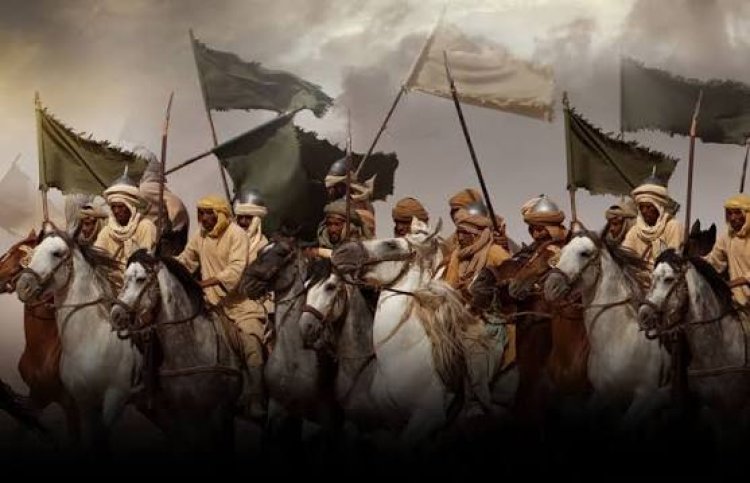
Analysis
By Umer Iqbal
How did a small polity in western Arabia evolve into the dominant political and military power of the Arabian Peninsula within a decade?
In the early spring of 627 AD, a coalition force of several thousand fighters, drawn from Mecca and allied Bedouin tribes, marched on Medina. Their goal was simply to subdue the young Muslim community before it grew any stronger. Medina had no walls and no professional garrison. By the usual arithmetic of Arabian warfare, the city should have fallen within days. It did not. On the advice of a companion (sahabi) named Salman, Prophet Muhammad ordered to dig a trench across the one stretch of open ground where cavalry could reach the city. Salman had learned the technique in Persia. The rest of Medina was already shielded by rock outcrops, orchards, and dense housing. The siege became a stalemate neither side had trained for. Weeks passed. Food ran short in the besiegers' camp. According to the early biographical tradition, a recent convert named Nu'aym ibn Mas'ud moved between the Meccan confederates and their nominal Jewish allies inside Medina, planting suspicion that each side had already struck a private deal with Prophet Muhammad. A violent desert storm tore through the camp, and the coalition (already fraying) came apart. The coalition army withdrew without fighting a major battle.
Nothing about the Battle of the Trench normally fits the popular image of seventh-century Arabian warfare, which was usually a contest of swordsmen and camel charges. It was decided by engineering, by intelligence about the enemy camp, and by the deliberate unraveling of a fragile alliance. That pattern, more than any single feat of arms, defines Prophet Muhammad's record as a military leader across the following decade. Prophet Muhammad fought like a strategist and a statesman rather than a battle warrior. This difference matters and bestows a consequential advantage.
Prophet Muhammad himself led as well as authorized dozens of military expeditions between 622 AD and 632 AD. These range from small raids to the mobilization of ten thousand men against Mecca. Historians have long debated what made this campaign of expansion succeed where so many tribal alliances in Arabia had mostly failed. The most persuasive answer is not romantic. Prophet Muhammad obviously and willfully combined strategic vision, working intelligence, calculated deception, mobility, disciplined organization, and adaptability after every setback. He welded these kinetic tools together with diplomacy, treating almost every military decision as also a decision about governance.
Prophet Muhammad's first and most consequential strategic decision was not a battle at all. In 622, facing growing hostility in Mecca, he and his followers relocated to the oasis town of Yathrib, soon renamed Medina. Military historians would call this a shift in center of gravity: the source of an army's staying power. The move gave the Muslim community a defensible base, a friendlier population, and access to trade routes running north toward Syria. Inside Medina, Prophet Muhammad negotiated an agreement among the town's Arab and Jewish clans, often called the Constitution of Medina, that established him as arbiter of disputes and organizer of collective defense. The document reads less like scripture than like a treaty of mutual security. It gave a scattered, minority movement something it never had in Mecca: territory, a hinterland, and the beginnings of a state.
Reconnaissance mattered as much as revelation in Prophet Muhammad's campaigns. Before the Battle of Badr in 624 AD, scouts tracked a Meccan trade caravan and reported on the size of the relief force Mecca sent to protect it. Prophet Muhammad positioned his smaller force to control the area's wells, denying the larger Meccan army easy access to water. It was a clear use of terrain and logistics against superior numbers. Sun Tzu wrote that foreknowledge is the foundation of victory, and Prophet Muhammad's campaigns bear that out repeatedly. Before the march on Mecca in 630, he kept his objective secret even from most of his own commanders. When a supporter named Hatib ibn Abi Balta'a tried to send a warning letter ahead to his relatives in the city, the letter was intercepted before it arrived. The march proceeded, and Mecca surrendered with barely a skirmish. Operational security was not incidental to that outcome. It produced the outcome. By concealing the expedition’s destination, limiting knowledge of the objective even within his own ranks, and intercepting Hatib ibn Abi Balta’a’s warning letter before it reached Mecca, Prophet Muhammad deprived the Quraysh of the opportunity to organize an effective defence or mobilize their forces. This strategic surprise enabled the Muslim army to approach the city largely unopposed, making operational security a decisive factor in Mecca’s largely peaceful surrender. (Here, “operational security” is used as a modern analytical concept to describe the deliberate protection of military intentions and movements, rather than as a contemporary seventh-century military doctrine).
Much of the fighting attributed to Prophet Muhammad's era took the form of the ghazw, a raiding tradition already familiar across Arabia: small, mobile bands striking quickly and withdrawing before a larger force could respond. Some modern historians compare this to guerrilla warfare, and the comparison illuminates something real. Both methods rely on factors such as mobility, surprise, and, importantly, the refusal to meet a stronger enemy on the enemy's own terms. But the comparison has limits too. Prophet Muhammad was not fighting a foreign occupier from the margins of an established state. Prophet Muhammad was building a state himself. The raids doubled and became instrumental in alliance-building, putting economic pressure on Meccan trade, and the gradual absorption of neighbouring tribes into a growing coalition. A guerrilla movement typically seeks to outlast an occupier. In Prophet Muhammad's case, the raids were not simply carried out in the service of an existing government or an established state. Rather, Prophet Muhammad’s early campaigns were instrumental in creating this theo-state. The strategy used was multi-pronged. While Military expeditions helped consolidate political authority, some raids forged tribal alliances. Finally, these culminated in the institutional foundations of the emerging polity in Medina.
If any single episode illustrates Prophet Muhammad's diplomatic skill, it would be the treaty of Hudaybiyyah in 628. Marching toward Mecca with over a thousand followers, ostensibly to perform pilgrimage, Prophet Muhammad found the city's gates barred. Rather than force a confrontation he could not be certain of winning, the Prophet chose to negotiate a ten-year truce on terms his own companions considered humiliating. The pilgrimage would wait a year. Any Muslim who defected to Mecca would not be returned, while the reverse applied to Meccans joining Medina. Umar ibn al-Khattab reportedly protested the deal outright. Prophet Muhammad accepted it anyway. The treaty was an exercise in what strategists now call strategic patience: accepting short-term disadvantage for a longer-term shift in the balance of power. Freed from open war with Mecca for two years, Prophet Muhammad's alliances expanded across Arabia. When a Meccan-allied tribe attacked an ally of Medina in 630 and broke the truce, Prophet Muhammad had both the pretext and the strength to take Mecca outright. He did so with minimal kinetic violence. Historians such as Michael Lecker have shown how much of this expansion rested on patient, individually negotiated relationships with tribal leaders rather than any single dramatic victory.
Not every campaign went as planned, and Prophet Muhammad's response to failure reveals as much as his successes. At Uhud in 625, Muslim forces held an early advantage until a company of archers, posted on high ground to guard the army's flank, abandoned their position to gather spoils from the retreating enemy. A Meccan cavalry commander, Khalid ibn al-Walid, exploited the gap immediately, and the battle turned into a costly reversal. Prophet Muhammad himself was wounded. What followed mattered more than the defeat. Later campaigns show a marked emphasis on holding formation, obeying assigned positions regardless of apparent opportunity, and building defensive works rather than relying on open engagement, a shift that culminated two years later in the trench dug outside Medina. Armies rarely improve through victory alone. Prophet Muhammad's forces improved through Uhud.
None of this worked without organization. Early Muslim expeditions were executed under a clear chain of command. Prophet Muhammad, or an appointed deputy, set strategy while subordinate commanders retained tactical discretion on the ground. It was a structure close to what modern armies call mission command(decentralized execution under a single unifying authority). Proper Rules regulated the treatment of captives, the distribution of captured property (maal-e-ghaneemat), and conduct toward noncombatants. These rules were not merely proclaimed but enforced. At Hunayn in 630 AD, an ambush by allied Hawazin and Thaqif fighters scattered the Muslim vanguard in a narrow valley. Prophet Muhammad and a core of close companions held their ground and rallied the retreating force within minutes, turning near-collapse into decisive victory. It was a demonstration of what modern scholars may call decision-cycle advantage, i.e. recovering faster than the enemy can exploit an opening. The expedition to Tabuk later that year, mounted in response to rumours of a Byzantine threat on the northern frontier, tested organization in a different way. This group of fighters is remembered in Islamic tradition as the army of hardship and preemptive sacrifice. It marched through drought at harvest time (the expedition could risk a food supplies shortage) toward an enemy that never actually appeared. No battle was fought, yet the expedition still achieved a strategic result. Several communities along the route submitted to Prophet Muhammad's authority rather than risk confrontation with a force capable of reaching them at all. That is deterrence in its plainest form, and it depended entirely on the logistical capacity to move thousands of men and animals across difficult terrain and bring them home again.
Montgomery Watt described Prophet Muhammad as both prophet and statesman, and the military record supports the pairing. Victories were rarely treated as endpoints in themselves. After the siege of Khaybar in 628, Prophet Muhammad negotiated terms allowing the defeated Jewish agricultural communities to remain and work the land under new arrangements, extending Medina's resources without requiring permanent occupation. The episode also included harsher measures, including executions that later historians have examined with considerable unease, and it remains one of the more morally contested chapters of the period. After Hunayn, Prophet Muhammad distributed captured wealth generously among recently defeated Meccan and Bedouin leaders to secure their loyalty. This decision visibly strained the patience of his original Medinan supporters, the Ansar, and Prophet Muhammad had to personally address to repair the rift. These events show a leader managing what modern analysts would call civil-military relations. Prophet Muhammad had to tacitly balance the demands of the mujahideen army against the cohesion of the wider muslim community he was building. By his death in 632 AD, military organization and Jihad had already become one strong thread in a larger institutional fabric that also now included law, arbitration, and treaty-making. Fred Donner and Hugh Kennedy have both argued that the administrative and military templates established in this period shaped the far larger conquests carried out by Prophet Muhammad's successors within a decade of his death.
The Qur'an's treatment of armed conflict developed over time rather than appearing as a single fixed doctrine. For instance, Verses revealed in Mecca, when the earliest Muslims had no state or army, counsel patience and restraint under persecution. After the move to Medina, verses permitting and then regulating warfare appear. These are framed initially around self-defence and the protection of a persecuted community, and later addressing truce-breaking, the treatment of prisoners, and the conduct of a fledgling state at war. Michael Bonner's work traces how these scattered verses were organized into a more systematic legal doctrine of jihad only in the centuries after Prophet Muhammad's death. Jurists in different schools of Islamic law developed distinct, sometimes conflicting interpretations of when force was permitted, against whom, and under what restraint. One prominent advocate of Jihad in Islamic Jurisprudence is Imam Sheikh Ibn Taymmiyah. Those interpretive traditions have never been uniform. They have shifted across centuries and remain contested today. Reducing Prophet Muhammad's era to either pure pacifism or perpetual holy war flattens a far more complicated record, and most serious historians of the period resist both simplifications.
Reconstructing any of this requires care about sources. The Qur'an is a near-contemporary text but offers little narrative detail about specific campaigns. The earliest connected biography, composed by Ibn Ishaq, survives mainly through a later recension by Ibn Hisham, compiled more than a century after Prophet Muhammad's death. Al-Waqidi's detailed campaign histories, written slightly later still, are prized by historians for military detail and treated cautiously for reliability. John Keegan has warned (generally) against military histories which attempt to turn commanders into isolated geniuses, detached from the societies and armies that made their campaigns possible. This caution applies here too. Prophet Muhammad's success vitally rested on committed followers, a receptive social environment in Medina, and the gradual exhaustion of Meccan resolve and social willpower. It is not tactical brilliance alone.
What keeps this period and phenomenon under active study is the co-occurrence of distinct successes in a surprising span of time. It is a case in which military organization, diplomacy, and religious authority were built simultaneously, by the same hand, in roughly a decade. Few episodes in world history offer historians a comparably compressed view of a state, an army, and a faith taking shape together.
Disclaimer: This paper is the author's individual scholastic contribution and does not necessarily reflect the organization's viewpoint.