12 Years of Governance: Key Achievements of the Modi Government
 usanasfoundation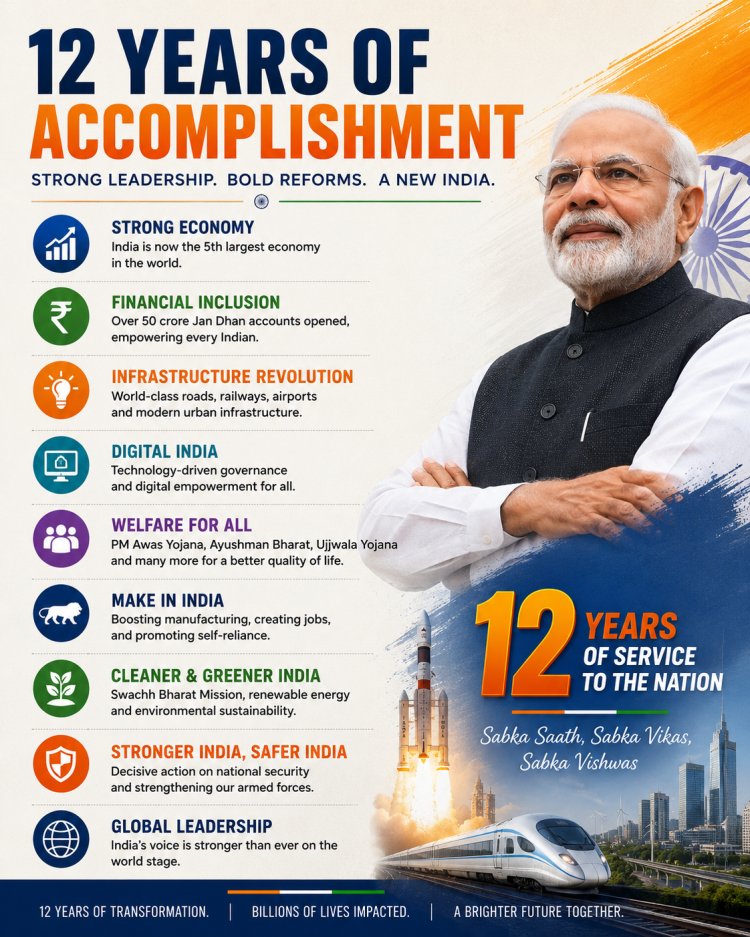
Factsheet
Compiled By - Mahima Katiyar, Research Intern
Edited By- Preeti Khenta, Associate Fellow
Prime Minister Narendra Modi has distinguished himself as the longest-serving democratically elected Prime Minister of India, having completed 12 years in office. India, under his leadership, has achieved significant milestones across domains, including defence, finance, and socio-economic development. Over the years, the nation has experienced political stability, comprehensive economic reforms, and enhanced global standing. Notable achievements have been observed in welfare delivery, national security, and technological advancement, reflecting transformative changes within the country. Below is an overview of his accomplishments over 12 years in leadership.
DEFENCE DOMAIN
SECTION A: DEFENCE BUDGET & RESOURCE MODERNISATION
Overall Defence Budget Allocation:
- 2014-15 Baseline: ₹2.53 lakh crore
- 2025-26 Latest Figure: ₹6.81 lakh crore
- Growth Achieved: Approximately 169% increase (from 2013-14 to 2025-26)
Capital Outlay on Defence Services:
- 2025-26 Latest Figure: ₹1.80 lakh crore (26.43% of total allocation)
- Growth Achieved: 4.65% higher than BE of FY 2024-25
- Official Source: Press Information Bureau (PIB)
- Allocation for Procurement from Domestic Industries (Modernisation Budget):
- 2025-26 Latest Figure: ₹1.11 lakh crore (75% of modernisation budget earmarked for domestic procurement)
Defence Pension Allocation:
- 2025-26 Latest Figure: ₹1.61 lakh crore
- Growth Achieved: 13.87% higher than FY 2024-25 allocation
Defence R&D Budget (DRDO):
- 2025-26 Latest Figure: ₹26,816.82 crore
- Growth Achieved: 12.41% higher than BE of FY 2024-25
iDEX Scheme Allocation:
- 2025-26 Latest Figure: ₹449.62 crore
- Growth Achieved: Almost three times increase in two years
Indian Coast Guard (ICG) Capital Budget:
- 2025-26 Latest Figure: ₹5,000 crore
- Growth Achieved: 43% increase from FY 2024-25
Border Roads Organisation (BRO) Capital Head Allocation:
- 2025-26 Latest Figure: ₹7,146.50 crore
- Growth Achieved: 9.74% higher than BE of FY 2024-25
SECTION B: ATMANIRBHAR BHARAT IN DEFENCE
Indigenous Defence Production:
- 2014-15 Baseline: ₹46,429 crore
- FY 2023-24 Latest Figure: ₹1,27,434 crore
- FY 2024-25 Highest-ever Defence Production: ₹1.54 lakh crore
- Growth Achieved: 174% surge from 2014-15 to 2023-24
- Target: ₹3 lakh crore by 2029
Positive Indigenisation Lists (PILs):
- Total PILs by DMA: Five lists comprising 411 military items
- Total PILs by DDP: Four lists comprising 4,666 items (Line Replacement Units/Sub-systems/Spares & Components for DPSUs)
MSME Participation:
- Number of MSMEs: 16,000 emerging as game-changers
- Official Source: Press Information Bureau (PIB)
- Industrial Licenses:
- Number of Licenses Issued: 788 industrial licenses issued to 462 companies
Defence Acquisition Procedure (DAP) 2020:
- Key Features: Indian First Approach (prioritizing Buy {Indian-IDDM}), streamlined approval processes, focus on cutting-edge technologies (AI, robotics, cyber, space), collaborative ecosystem with private sector, startups, and MSMEs
Defence Procurement Manual (DPM) 2025:
- Launch Date: October 2025
- Effective Date: November 1, 2025
- Key Reforms: Ease of Doing Business, support for innovation and indigenisation, industry-friendly provisions (lower liquidated damages, guaranteed orders for indigenous products, removal of No Objection Certificate), digital integration and transparency
SECTION C: DEFENCE EXPORTS
Defence Exports Value:
- 2013-14 Baseline: ₹686 crore
- FY 2024-25 Latest Figure: ₹23,622 crore
- FY 2025-26 Record Figure: ₹38,424 crore
- Growth Achieved: Over 5500% increase from 2013-14 to 2025-26
- Target: ₹50,000 crore by 2029
Export Growth:
- FY 2025-26: 62.66% increase over the previous fiscal
- Last Five Years: Around a three times increase
Major Defence Platforms Exported:
- Dornier-228, 155 mm Advanced Towed Artillery Guns, Brahmos Missiles, Akash Missile System, Radars, Simulators, Mine Protected Vehicles, Armoured Vehicles, PINAKA Rockets & Launchers, Ammunitions, Thermal Imagers, Body Armours, Systems, Line Replaceable Units and Parts & components of Avionics and Small Arms
- Growing global demand for LCA-Tejas, Light Combat Helicopters, Aircraft Carrier, and MRO activities
Private Sector Participation:
- FY 2025-26 Contribution: ₹17,353 crore (45.16% of total exports)
- Growth: 14% increase compared to previous year
- Official Source: Ministry of Defence
DPSUs Contribution:
- FY 2025-26 Contribution: ₹21,071 crore (54.84% of total exports)
- Growth: 151% increase compared to previous year
SECTION D: ARMED FORCES MODERNISATION
INDIAN ARMY
Infantry Modernisation:
- Procurement of Light Armoured Multipurpose Vehicles
- Procurement of 7.62x51 mm Light Machine Gun
Artillery Modernisation:
- Procurement of 155mm/52 Caliber ATAGS (Advanced Towed Artillery Gun System) along with High Mobility & Gun Towing Vehicles
Integrated Battle Systems:
- Procurement of Ground-Based Autonomous System for mechanised infantry and armoured regiments
INDIAN AIR FORCE
Rafale Induction:
- Induction of 36 Rafale fighter jets with Meteor and SCALP missiles
- Procurement of 26 Rafale Marine aircraft for the Indian Navy
LCA Tejas:
- Expansion of Tejas indigenous fighter aircraft program
- First twin-seater Light Combat Aircraft ‘Tejas’ handed over to IAF
- IAF placed an order for 83 LCAs with HAL
Advanced Aircraft Procurement:
- Procurement of 12 Su-30 MKI Aircraft
- Upgradation of Su-30 MKI aircraft indigenously from HAL
- Induction of C-295 MW transport aircraft (15 in flyaway condition, 40 to be manufactured in India)
Air Defence Systems:
- Procurement of Automated Air Defence Control & Reporting System ‘Project Akashteer’
INDIAN NAVY
- Growing global demand for Indian-made Aircraft Carriers
- Funding for next-generation submarines/ships/platforms
- Growing global demand for Indian-made warships
Naval Aviation:
- Procurement of 26 Rafale Marine aircraft
- Procurement of Medium-Range Anti-Ship Missiles for surface platform
- Procurement of Sarang Electronic Support Measure systems
- Procurement of 13 Lynx-U2 Fire Control Systems
SECTION E: STRATEGIC & MISSILE CAPABILITIES
Agni Series:
- Premier long-range, nuclear-capable surface-to-surface ballistic missile series
- Agni-I (700-800 km), Agni-II (2,000+ km), Agni-III (3,000+ km), Agni-IV (3,500+ km), Agni-V (5,000+ km ICBM) are operational
- Agni-P (Prime) (1,000-2,000 km) advanced next-gen, canister-based
- Agni-VI (nearly 12,000 km range, enhanced payload) under development
- Agni-5 missile with MIRV (Multiple Independently Targetable Re-entry Vehicles) capability successfully test-fired
BrahMos:
- Long-range, ramjet-powered supersonic cruise missile (Mach 2.8)
- Can be launched from submarines, ships, and fighter aircraft
- Joint venture between DRDO and Russia’s NPO Mashinostroyeniya
- Range enhanced after India joined MTCR in 2016
- BrahMos-NG (Next Generation) under development (290 km range, Mach 3.5 speed)
- Procurement of BrahMos missiles for Indian Navy
- Procurement of Brahmos Launcher and Fire Control System for Shivalik class of ships & Next Generation Missile Vessels
Akash:
- Akash missile (Akash-NG) system trials completed, successfully intercepted aerial targets
Astra:
- Astra air-to-air missile (AAM) program with world-class variants soon
Ballistic Missile Defence (BMD):
- Two-tiered Ballistic Missile Defence system
Long Range Precision Strike Capabilities:
- Smart Anti-Airfield Weapon (SAAW) developed by DRDO (125 kg glide bomb, 100 km range)
- Pralay (150–500 km) canisterised, solid-fuel, battlefield missile
- Prahaar (150 km) quick-reaction, all-weather, high-precision missile
SECTION F: DRDO & DEFENCE R&D
Major DRDO Successes:
- Increased budgetary allocation to DRDO: ₹26,816.82 crore in FY 2025-26
- Major share of ₹14,923.82 crore allocated for capital expenditure and R&D projects
- Developing new technologies with a focus on fundamental research and private sector collaboration
Advanced Technologies:
- Focus on new domains such as Cyber & Space and emerging technologies like Artificial Intelligence (AI), Machine Learning and Robotics
- Corpus of Rs 500 crore approved for deep-tech and cutting-edge projects under Technology Development Fund (TDF) scheme
- 15 Defence Industry-Academia Centres of Excellence (DIA-CoEs) established
Defence Innovation:
- Strengthening the start-up ecosystem for innovation in defence
- iDEX scheme allocation of ₹449.62 crore for funding projects
SECTION G: MILITARY REFORMS
Creation of Chief of Defence Staff (CDS):
- Position approved by Cabinet in 2019
- First CDS, General Bipin Rawat, took on the roles of head of DMA and Permanent Chairman of COSC
- Empowered to issue Joint Orders for all three services (June 2025)
Department of Military Affairs (DMA):
- Established under the Ministry of Defense to improve cooperation and streamline procurement, staffing, and training
- CDS acts through DMA to issue Joint Instructions and Orders
Jointness and Integration:
- CDS emphasizes “Jointness 2.0” to foster a joint culture in the armed forces
- CDS empowered to issue single-point orders, establishing a unified chain of command
Theatre Command Progress:
- Moving closer to establishing Integrated Theatre Commands (ITCs)
- CDS granted command authority to build ITCs
- Future Land Theatre Command likely centred around existing Army Commands (Northern, Eastern, Western)
Procurement Reforms:
- Simplification in Defence Procurement Procedure to ensure optimum utilisation of allocation
- Implementation of Defence Acquisition Procedure (DAP) 2020 and Defence Procurement Manual (DPM) 2025
Agnipath Scheme:
- Approved by Union Cabinet in June 2022 for recruitment to the armed forces
- Agniveers serve for four years, with up to 25% absorbed into the regular cadre
- Aims to enhance youthful profile and reduce pension expenditure in the long term
SECTION H: BORDER INFRASTRUCTURE & OPERATIONAL READINESS
Border Roads Organisation (BRO) Achievements:
- Roads Built: Over 64,100 kms of roads since 1960 (around 4,595 km built between FY 2020-21 and 2024-25)
- Bridges Built: 1,179 bridges
- Tunnels Built: 7 tunnels
- Airfields Built: 22 airfields
Strategic Bridges:
- Siyom Bridge and Sisseri River Bridge in Arunachal Pradesh
- Devak Bridge (422.9 m) in Jammu & Kashmir
Forward Connectivity & Tunnels:
- Atal Tunnel (9.02 km) in Himachal Pradesh, world’s longest highway tunnel above 10,000 ft
- Sela Tunnel (13,000 ft) in Arunachal Pradesh
- Nechiphu Tunnel (500 m) in Arunachal Pradesh
- Shyok Tunnel (920 m) in Ladakh
Advanced Landing Grounds & Airfields:
- Reconstruction of Bagdogra and Barrackpore airfields in West Bengal
Border Infrastructure Projects:
- 356 infrastructure projects executed by BRO dedicated to the nation in 2024 and 2025
- Highest-ever expenditure of ₹16,690 crore in FY 2024-25
SECTION I: MARITIME SECURITY & INDO-PACIFIC
SAGAR Initiative:
- Security and Growth for All in the Region (SAGAR) vision
- Indian Ocean Ship (IOS) SAGAR initiative to strengthen maritime partnership with Indian Ocean nations
- Second edition commenced in March 2026 with participation from 16 IONS nations
- MAHASAGAR (Mutual and Holistic Advancement for Security Across the Regions) framework
Naval Exercises & Partnerships:
- IOS SAGAR includes professional training interactions and deployment onboard Indian Naval Ships for personnel from Friendly Foreign Countries
SECTION K: SPACE, CYBER & EMERGING WARFARE CAPABILITIES
Defence Space Agency (DSA):
- Creation approved in September 2018, fully operational in November 2019
- Tri-service agency tasked with operating space warfare and satellite intelligence assets
- Collaborating with DRDO to develop systems for expanding defence and offense capabilities in space
Anti-Satellite Capability:
- “Mission Shakti” (March 2019): First successful test of an anti-satellite weapon (ASAT)
Defence Cyber Agency (DCA):
- Created along with DSA as a tri-service agency
Information Warfare Capabilities:
- Development of systems for providing high-quality Signal Intelligence (SIGINT), Communication Intelligence (COMINT), and Electronic Intelligence (ELINT)
Space Defence Initiatives:
- Development of domestic global navigation satellite system (GNSS) called NavIC (Navigation with Indian Constellation) to reduce dependence on foreign systems
SECTION K: DEFENCE DIPLOMACY & STRATEGIC PARTNERSHIPS
- Exporting defence equipment to more than 80 countries
- IOS SAGAR initiative engaging naval personnel from 16 Friendly Foreign Countries
INTERNAL SECURITY DOMAIN
SECTION A: COUNTER-TERRORISM AND JAMMU & KASHMIR
Zero Tolerance Policy:
PRAHAAR (2026) - India's first comprehensive National Counter-Terrorism Policy and Strategy, launched by the Ministry of Home Affairs. It adopts an intelligence-led, zero-tolerance approach to tackle evolving terror threats, transnational hybrid warfare, and modern challenges like cyber-terrorism, dark-web financing, and weaponized drones.
Terror Incidents in Jammu & Kashmir (J&K):
- 2014-2026 Trend: Significant decline in terror-related incidents, with a reported 43-50% reduction over the last decade
- Post-Abrogation of Article 370 (2019): Record decline in civilian deaths and security force fatalities
- Stone Pelting Incidents: From 2,654 incidents in 2010 to virtually zero incidents in 2023-2026, reflecting restored law and order
- Organized Hartals: Eliminated, contributing to normalcy and economic activity
Terror Financing Crackdown:
- Intensified crackdown by the National Investigation Agency (NIA) on terror financing networks, with multiple assets attached and cases registered
Tourism in J&K:
- Record-breaking footfall, with over 2 crore tourists in 2023 and projected over 2.5 crore in 2025-26, reflecting restored normalcy and confidence
SECTION B: LEFT WING EXTREMISM (LWE)
Affected Districts:
- 2014 Baseline: 126 districts
- 2024 Latest Figure: 38 districts
- 2025-26 Latest Figure: Reduced to just 11 districts, with LWE reported to be “on the verge of ending”
- Growth Achieved: Over 90% reduction in the geographical spread of LWE.
Violence Reduction:
- Over 77% reduction in LWE-related violent incidents since 2010
- Near 100% decline in violence in many previously high-intensity areas by 2026
Security Forces Reach:
- Expansion of “Forward Operating Bases” (FOBs) in core LWE areas like Abujhmad, significantly shrinking the operational space for extremists
SECTION C: NORTH EAST SECURITY
Insurgency Incidents:
- 2014-2022 Trend: 76% reduction in extremist incidents
- Casualties: 90% reduction in security force casualties and 95% reduction in civilian deaths compared to previous decades
AFSPA Withdrawal:
- Armed Forces (Special Powers) Act (AFSPA) withdrawn from large parts of Assam, Nagaland, and Manipur due to significantly improved security conditions
Peace Accords:
- Successful signing and implementation of multiple historic peace accords, integrating former insurgents into the mainstream:
- Bodo Accord (2020)
- Bru-Reang Agreement (2020)
- Karbi Anglong Agreement (2021)
- NLFT-Tripura Agreement (2019)
- ULFA Peace Accord (2023)
SECTION D: NARCOTICS CONTROL
Seizure Statistics:
- 2006-2013 Baseline: 1.52 lakh kg of drugs seized
- 2014-2023 Latest Figure: 3.94 lakh kg of drugs seized
- Growth Achieved: Approximately 160% increase in drug seizures, reflecting intensified anti-narcotics operations.
Destruction Milestones:
- Historic milestone of destroying 10 lakh kg of seized drugs in a single year (July 2022 – July 2023), valued at over ₹12,000 crore
- Continued large-scale destruction campaigns, including 1.37 lakh kg destroyed in September 2025
Nasha Mukt Bharat Abhiyaan (NMBA):
- Coverage: Expanded from 272 vulnerable districts to all districts nationwide
- Reach: Reached over 11 crore people, including 3.5 crore youth and 2.3 crore women, creating a mass movement against drug abuse
Institutional Framework (NCORD):
- Establishment of the 4-tier National Narcotics Coordination (NCORD) portal to enhance coordination among various law enforcement agencies.
SECTION E: CYBER SECURITY
Indian Cyber Crime Coordination Centre (I4C):
- National Cybercrime Reporting Portal (cybercrime.gov.in) accessed over 230 million times
- Complaints: Over 8.2 million cybercrime-related complaints received as of November 2025
- Daily Complaints: Handling approximately 4,200-5,000 complaints per day, indicating high citizen trust and reporting
Financial Fraud Prevention:
- “Citizen Financial Cyber Fraud Reporting Management System” has successfully saved over ₹1,200 crore of citizens’ money from cyber fraudsters (as of 2024-25)
Infrastructure and Verification:
- Establishment of the National Cyber Forensic Laboratory (NCFL).
- Implementation of the Cyber Safe Portal for verification of SIMs and IMEIs to curb cybercrime.
SECTION F: BORDER MANAGEMENT
Smart Fencing (BOLD-QIT):
- Deployment of Border Electronically Dominated QRT Interception Technique (BOLD-QIT) along vulnerable riverine borders (e.g., Dhubri, Assam) where physical fencing is not feasible
- Implementation of the Comprehensive Integrated Border Management System (CIBMS) providing 24x7x365 surveillance using advanced sensors, cameras, and radars
Border Infrastructure and Fencing:
- Indo-Pakistan Border: Nearly 95% physical fencing has been completed.
- Indo-Myanmar Border: In-principal approval granted in 2024-25 for 1,643 km of fencing and road construction to secure the eastern frontier
- Border Roads: Construction pace increased significantly from ~600 km/year to >1,200 km/year, enhancing strategic mobility.
Vibrant Villages Programme (VVP):
- Phase I: 2,558 projects sanctioned with an outlay of ₹3,431 crore
- Phase II (VVP-II): Approved in April 2025 with an outlay of ₹6,839 crore till FY 2028-29
- Focus: Comprehensive development of infrastructure, connectivity, and livelihood in 2,967 border villages across Arunachal Pradesh, Sikkim, Uttarakhand, Himachal Pradesh, and Ladakh to prevent out-migration and enhance border security
SECTION G: POLICE MODERNIZATION AND FORENSIC SCIENCE
Crime and Criminal Tracking Network & Systems (CCTNS):
- Achieved 100% coverage across over 17,000 police stations nationwide, enabling seamless data sharing and crime tracking.
Forensic Infrastructure:
- Establishment of the National Forensic Sciences University (NFSU) in 2020, with campuses expanding to multiple states, including Goa, Tripura, and Manipur.
- Target: Establishing one forensic science laboratory in every district by 2029 to expedite criminal justice delivery.
Legislative Reforms (UAPA and NIA Act):
- NIA Act Amendment (2019): Empowered NIA to investigate terror acts against Indians abroad and expanded jurisdiction to include human trafficking and cyber-terrorism
- UAPA Amendment (2019): Empowered the Central Government to designate individuals as terrorists and allowed NIA to attach properties without prior state police permission
- Conviction Rate: NIA maintained a record high conviction rate of >94% (as of 2024-25)
AGRICULTURAL DOMAIN
SECTION A: BUDGETARY ALLOCATION AND SECTORAL GROWTH
Budget Allocation for Agriculture:
- 2013-14 Baseline: ₹27,633 crore
- 2025-26 Latest Figure: Over ₹1.4 lakh crore
- Growth Achieved: A substantial increase of over 5 times in funding, underscoring the government’s commitment to farmer welfare and agricultural development.
Agriculture Sector Growth:
- The sector has demonstrated sustained positive growth, maintaining resilience even amidst global economic fluctuations. This consistent growth has been crucial for overall economic stability and rural prosperity.
SECTION B: PRODUCTION MILESTONES AND GLOBAL STANDING
Foodgrain Production:
- 2013-14 Baseline: 265.05 million metric tonnes (MMT)
- 2024-25 Latest Figure: 357.73 MMT, marking a record high in foodgrain output
- Growth Achieved: A significant increase ensuring national food security and contributing to exportable surpluses.
Horticulture Production:
- 2013-14 Baseline: 277.35 MMT
- 2024-25 Latest Figure: 362.08 MMT
- Growth Achieved: This substantial growth reflects a strategic shift towards high-value horticulture crops, diversifying agricultural income.
Global Ranking in Agricultural Commodities:
- Ranked 1st globally in the production of Milk, Spices, Pulses, Tea, Cashew, and Jute.
- Ranked 2nd globally in the production of Rice, Wheat, Fruits, and Vegetables.
SECTION C: FARMER WELFARE AND INCOME SUPPORT INITIATIVES
PM-KISAN (Pradhan Mantri Kisan Samman Nidhi):
- Total Disbursed (since 2019): Over ₹4.3 lakh crore has been directly transferred to farmers’ bank accounts
- Beneficiaries: More than 11 crore farmers across the nation receive direct income support, enhancing their financial stability.
PMFBY (Pradhan Mantri Fasal Bima Yojana):
- Farmers Insured: Over 4.4 crore farmers are currently insured, with a cumulative total of over 92.5 crore applications since the scheme’s inception
- Claims Paid: Over ₹1.6 lakh crore has been disbursed to farmers as claims, against a premium collection of ₹32,000 crores, providing crucial risk coverage.
Minimum Support Price (MSP) Policy:
- Policy Reform: MSP for all mandated crops has been fixed at a minimum of 1.5 times the all-India weighted average cost of production since 2018-19, ensuring remunerative prices for farmers.
- Cumulative MSP Payout: The value of MSP procurement surged from ₹7.41 lakh crore during 2004-2014 to ₹26.32 lakh crore during 2014-2026, marking over a 3.5-fold increase in direct payments to farmers.
- Paddy Procurement Value: Increased from ₹4.4 lakh crore (UPA Era, 2004-14) to ₹12.51 lakh crore (Modi Era, 2014-26).
- Wheat Procurement Value: Increased from ₹2.41 lakh crore (UPA Era, 2004-14) to ₹6.54 lakh crore (Modi Era, 2014-26).
- Farmers Benefitted: The number of paddy farmers benefitting from MSP procurement has significantly increased from 1.2 crore in 2019, with over 22 lakh wheat farmers benefitting in recent seasons alone
- PM-AASHA (Pradhan Mantri Annadata Aay Sanrakshan Abhiyan): Over 99.3 lakh farmers have benefitted through the procurement of pulses, oilseeds, and copra since 2018, with over ₹1 lakh crore disbursed under its various components (Price Support Scheme, Price Deficiency Payment Scheme, Private Procurement & Stockist Scheme)
SECTION D: AGRICULTURAL INFRASTRUCTURE AND MARKETING REFORMS
Agri Infrastructure Fund (AIF):
- Fund Size: A ₹1 lakh crore fund dedicated to creating post-harvest management infrastructure and community farming assets.
- Loan Target: The loan target has been doubled to ₹2 lakh crore by February 2026, accelerating investment in critical agricultural infrastructure
- Projects Sanctioned: Over 74,508 projects have been sanctioned as of August 2024, mobilizing an investment of over ₹47,575 crore
- Employment Generation: These projects have generated over 8.19 lakh rural employment opportunities, boosting the rural economy
E-NAM (National Agriculture Market):
- Integration: 1,389 mandis (agricultural markets) have been integrated across 23 states and 4 Union Territories, creating a unified national market for agricultural produce.
- Registrations: Over 1.77 crore farmers and 2.5 lakh traders are registered on the platform.
- Trade Volume: Cumulative trade value has exceeded ₹3.5 lakh crore, facilitating transparent and efficient price discovery for farmers.
FPOs (Farmer-Producer Organisations):
- Promotion: A target to form and promote 10,000 new FPOs by 2027-28, with significant progress achieved by 2026, empowering farmers through collective bargaining and better market access.
SECTION E: TECHNOLOGY INTEGRATION AND DIGITAL AGRICULTURE
Digital Agriculture Mission:
- Approval: Approved with an outlay of ₹2,817 crore in 2024 to create a robust Digital Public Infrastructure for agriculture
- Goal: To digitize 6 crore farmers in the first phase and establish a unified platform for all agri-services, leveraging data for informed decision-making.
AgriStack:
- Creation of a comprehensive digital ecosystem including a Farmers’ Registry, Village-level Soil Maps, and a Crop Sown Registry, enabling targeted interventions and personalized advisories.
Kisan Drones:
- Promotion: Active promotion of drone technology for diverse agricultural applications, including crop assessment, nutrient spraying, and digitization of land records.
- Namo Drone Didi Scheme: Aims to provide drones to 15,000 selected Women Self Help Groups (SHGs) by 2026, with an 80% subsidy (up to ₹8 lakh) per drone. Over 1,000 drones were distributed to SHGs by early 2024, empowering women and modernizing farming practices
Soil Health Cards:
- Issuance: Over 23 crore Soil Health Cards have been issued to farmers, providing crucial information for optimizing fertilizer use and improving soil fertility.
Agri-Startups:
- 2013-14 Baseline: Fewer than 50 startups in the agri-allied sector.
- 2026 Latest Figure: Over 11,000 recognized agri-allied startups, driving innovation in supply chain management, precision farming, and financial inclusion.
UPAg Portal:
- The Unified Portal for Agricultural Statistics (UPAg) has been launched to provide real-time, credible, and comprehensive agricultural data for effective policy-making and research.
SECTION F: IRRIGATION AND SUSTAINABILITY INITIATIVES
PMKSY (Pradhan Mantri Krishi Sinchayee Yojana):
- Focus: Emphasizes ‘Per Drop More Crop’ through efficient water management.
- Micro-irrigation Coverage: Over 80 lakh hectares have been brought under micro-irrigation, conserving water and enhancing productivity.
Paramparagat Krishi Vikas Yojana (PKVY):
- Promotion: Actively promotes organic farming through a cluster-based approach, fostering sustainable agricultural practices.
SECTION G: AGRICULTURAL EXPORTS
Export Value:
- 2013-14 Baseline: US$ 37.29 billion
- 2024-25 Latest Figure: US$ 51.1 billion
- Growth Achieved: Over 37% increase, reaching record levels and establishing India as a significant global agricultural exporter.
- Key Export Items: Major export items include marine products, non-basmati rice, sugar, and spices, contributing significantly to foreign exchange earnings.
SECTION H: DAIRY, LIVESTOCK, AND FISHERIES SECTORS
Milk Production (White Revolution):
- 2014-15 Baseline: 146.30 million tonnes
- 2023-24 Latest Figure: 239.30 million tonnes
- 2025-26 Estimate: Projected to exceed 250 million tonnes.
- Growth Achieved: Over 63% increase in a decade, with India contributing 25% of global milk production and maintaining its position as the world’s largest milk producer
Egg Production:
- 2014-15 Baseline: Approximately 78 billion eggs.
- 2023-24 Latest Figure: 142.77 billion eggs
- 2025-26 Latest Figure: Projected to reach 149.12 billion eggs, based on a consistent growth rate
- Global Ranking: India is the 2nd largest egg producer in the world.
Meat Production:
- The sector has witnessed significant growth in production and exports, further diversifying India’s agricultural economy.
Fisheries (Blue Revolution):
Fish Production:
- 2013-14 Baseline: 95.79 lakh tonnes.
- 2024-25 Latest Figure: 195 lakh tonnes, marking a record high
- Growth Achieved: Fish production has more than doubled in a decade, showcasing the success of targeted interventions.
PMMSY (Pradhan Mantri Matsya Sampada Yojana):
- Investment: A historic investment of ₹20,050 crore, the highest ever in the fisheries sector
- Target: Aims to increase fish production to 22 million metric tonnes by 2025-26
- Impact: Led to the modernization of fishing harbors, promotion of deep-sea fishing, and significant development in aquaculture.
SECTION I: ETHANOL BLENDING PROGRAMME (SUGAR SECTOR SUCCESS)
Blending Rate:
- 2013-14 Baseline: 1.53%
- 2024-25 Latest Figure: 17.98% (as of Feb 2025)
- 2025-26 Target: 20% (Target achieved ahead of schedule)
Foreign Exchange Savings:
- Saved over ₹1.84 lakh crore in foreign exchange through the Ethanol Blended Petrol (EBP) program
Impact on Sugar Sector:
- Ethanol has emerged as a major revenue stream for sugar mills, ensuring timely payments to sugarcane farmers.
SECTION J: FERTILIZER REVOLUTION (NEEM COATING & NANO UREA)
Neem Coated Urea (NCU):
- 100% neem coating of urea mandated since 2015 to prevent diversion to non-agricultural uses and improve soil health
Nano Urea:
- Capacity: Eight Nano urea plants with a combined production capacity of 44 crore bottles, equivalent to 195 LMT of conventional urea
- Impact: Reduced fertilizer subsidy burden and improved nutrient use efficiency.
- Official Source: Ministry of Chemicals and Fertilizers, Indian Farmers Fertiliser Cooperative Limited (IFFCO).
PM-PRANAM:
- Scheme launched to incentivize states to promote alternative fertilizers and reduce chemical fertilizer use.
- Official Source: Ministry of Chemicals and Fertilizers.
SECTION K: KISAN CREDIT CARD (KCC) EXPANSION
Eligibility Expansion:
- In 2018-19, KCC facility was extended to Fisheries and Animal Husbandry farmers for their working capital requirements
Saturation Drive:
- The “Ghar Ghar KCC” campaign has been launched to ensure every eligible farmer, including those in allied sectors, has access to formal credit.
Interest Subvention:
- KCC loans benefit from a 2% interest subvention and an additional 3% incentive for prompt repayment, making credit more affordable for farmers.
SECTION L: SWEET REVOLUTION (HONEY PRODUCTION)
Production Growth:
- 2014-15 Baseline: Approximately 76,000 MT.
- 2025-26 Latest Figure: Approximately 1.4 lakh MT, demonstrating significant growth in honey production.
Exports:
- 2014-15 Baseline: 29,600 MT.
- 2025-26 Latest Figure: 1,14,570 MT
- Global Ranking: India has emerged as the 2nd largest exporter of honey in the world, a testament to the success of the “Sweet Revolution”
National Beekeeping & Honey Mission (NBHM):
- Launched with an outlay of ₹500 crore to promote scientific beekeeping and enhance honey production and quality.
ECONOMIC DOMAIN
SECTION A: MACROECONOMIC EXPANSION AND STABILITY
GDP Ranking:
- 2014 Baseline: 10th largest economy globally
- 2025 Latest Figure: 4th largest economy globally
- Growth Achieved: Jumped 6 spots in a decade, surpassing major economies like the UK and France.
Nominal GDP:
- 2014-15 Baseline: ₹106.57 lakh crore
- 2024-25 Latest Figure: ₹331.03 lakh crore
- Growth Achieved: Tripled in a decade, reflecting robust economic expansion.
Real GDP Growth Rate:
- FY 2025-26: Projected 6.3% to 6.8%, with some estimates reaching 7.7%. India remains the world’s fastest-growing major economy.
Inflation Control:
- 2004-2014 Average: 8.2%
- 2015-2025 Average: Approximately 5%
- 2024-25 Retail Inflation: 4.6%, the lowest since 2018-19.
- Growth Achieved: Significant reduction and stabilization of inflation through targeted fiscal and monetary policies.
Foreign Direct Investment (FDI) Inflows:
- Cumulative (since 2014): US$ 1.05 trillion
- Growth Achieved: Record 27% increase in equity inflows in the first 9 months of FY25 alone, demonstrating strong investor confidence.
SECTION B: TRADE AND COMMERCE
Total Exports (Merchandise + Services):
- 2013-14 Baseline: ~US$ 466 billion (derived from merchandise and services exports)
- 2024-25 Latest Figure: US$ 825 billion
- Growth Achieved: 76% increase over the decade, driven by engineering goods, electronics, and pharmaceuticals.
Services Exports:
- 2013-14 Baseline: US$ 158 billion
- 2024-25 Latest Figure: US$ 387 billion
- Growth Achieved: More than doubled, establishing India as a significant global services hub.
SECTION C: INFRASTRUCTURE AND LOGISTICS
National Highways Length:
- 2014 Baseline: 91,287 km
- March 2026 Latest Figure: 1,46,572 km
- Growth Achieved: Approximately 61% increase, enhancing connectivity and logistics efficiency.
Railway Electrification:
- 2014 Baseline: Approximately 20% of the network
- March 2026 Latest Figure: 99.6% of the network
- Growth Achieved: Near total electrification, contributing to reduced carbon footprint and operational efficiency.
Vande Bharat Trains:
- 2026: 79 trains in service (as of May 2026)
- Growth Achieved: Rapid deployment of modern, semi-high-speed train sets across key routes.
Railway Safety (Kavach System):
- Implemented on >2,200 route kilometres (as of February 2026)
- Growth Achieved: Enhanced safety and accident prevention through an indigenous automatic train protection system.
Airports:
- 2014 Baseline: 74 airports
- 2026 Latest Figure: 164 airports
- Growth Achieved: More than doubled, significantly improving air connectivity, especially under the UDAN scheme.
Metro Rail Network:
- 2014 Baseline: 248 km across 5 cities
- 2025-26 Latest Figure: 1,095 km across 26 cities
- Growth Achieved: Over 4x expansion in length and significant increase in city coverage, promoting sustainable urban mobility.
Major Port Capacity:
- 2014-15 Baseline: 871.52 MTPA (Million Tonnes Per Annum)
- 2023-24 Latest Figure: 1,629.86 MTPA
- 2026 Estimate: Total port capacity (Major + non-Major) reached 2,762 MTPA [7]
- Growth Achieved: Substantial increase in handling capacity, bolstering maritime trade.
Cargo Volume (Major Ports):
- FY 2014-15 Baseline: 581 million tonnes
- FY 2024-25 Latest Figure: 855 million tonnes
- Growth Achieved: Significant increase in cargo throughput, indicating robust trade activity.
Logistics Performance Index (LPI):
- 2014: 54th rank globally
- 2023: 38th rank globally
- Growth Achieved: Improved 16 places, reflecting enhanced logistics efficiency and infrastructure.
Unified Logistics Interface Platform (ULIP):
- Integrated 30+ systems from 7 ministries, streamlining logistics operations
- Growth Achieved: Digitalization and integration of logistics ecosystem.
SECTION D: TELECOM AND DIGITAL INFRASTRUCTURE
Broadband Connections:
- March 2014 Baseline: 6.1 crore
- February 2026 Latest Figure: 105.27 crore (1052.72 million)
- Growth Achieved: Over 1600% increase, bridging the digital divide.
5G Rollout:
- 2014 Baseline: 0 subscribers
- 2025 Latest Figure: 40 crore subscribers
- Growth Achieved: Rapid deployment and adoption of 5G technology across the nation.
Aadhaar (Digital Identity):
- March 2026 Latest Figure: Over 144 crore Aadhaar numbers generated
- Growth Achieved: Universal digital identity coverage, enabling efficient service delivery.
Unified Payments Interface (UPI):
- 2024 Volume: 172 billion transactions
- Growth Achieved: 9x volume surge from FY18-FY24, making India a global leader in digital payments.
SECTION E: BANKING AND FINANCIAL INCLUSION
Asset Quality (Gross Non-Performing Assets – NPAs):
- 2018 Peak (GNPA): 11.18%
- 2025-26 Latest Figure (GNPA): Approximately 2.3% (projected based on recent trends)
- Growth Achieved: Significant reduction in NPAs, strengthening the health and resilience of the banking sector.
Financial Inclusion (Pradhan Mantri Jan Dhan Yojana – PMJDY):
- Accounts Opened: Over 52 crores (as of late 2024/2025)
- Growth Achieved: Bringing a vast unbanked population into the formal financial system.
- Official Source: Ministry of Finance, PMJDY Dashboard
Credit Growth:
- Sustained at approximately 15-16% year-on-year in FY26, supporting productive sectors of the economy
Provision Coverage Ratio (PCR):
- Increased to over 75% for most public sector banks, enhancing their ability to absorb potential losses
SECTION F: TAXATION AND FORMALISATION
Goods and Services Tax (GST):
- Launch: July 1, 2017.
- Taxpayer Base: Increased from approximately 66 lakh (2017) to over 1.5 crore (2026)
Revenue Growth:
- 2017-18: ₹8.76 lakh crore (Annualized)
- 2024-25: ₹22.08 lakh crore (Record High)
- Monthly Peak: Over ₹2.10 lakh crore (April 2025)
- Growth Achieved: Simplified indirect tax structure, increased transparency, and boosted revenue collection.
Direct Tax Reforms:
- Corporate Tax: Reduced to 22% (existing companies) and 15% (new manufacturing companies) in 2019
- Faceless Assessment: Introduced in 2020 to reduce human interface and increase transparency
- Tax Transparency: Introduction of Annual Information Statement (AIS) and Taxpayer Information Summary (TIS) for automated reporting
- Tax-to-GDP Ratio: Reached approximately 12% in FY26 (Combined Direct + Indirect)
- Growth Achieved: Modernized tax administration, encouraged investment, and improved compliance.
SECTION G: INDUSTRY AND MANUFACTURING
Mobile Manufacturing:
- 2014-15 Production Value: ₹18,000 crore
- 2024-25 Production Value: ₹5.45 lakh crore
- Growth Achieved: Approximately 28-fold rise, positioning India as the 2nd largest mobile manufacturer globally.
- Exports: Surged from US$ 0.2 billion (2017-18) to US$ 24.1 billion (2024-25)
Production Linked Incentive (PLI) Schemes (across 14 sectors):
- Total Outlay: ₹1.97 lakh crore
- Cumulative Investment: Over ₹2.16 lakh crore (as of February 2026)
- Incremental Production/Sales: Over ₹18.7 lakh crore
- Employment Created: Over 12.6 lakh new jobs
- Growth Achieved: Boosted domestic manufacturing, attracted global investments, and created employment.
Startup Ecosystem:
- 2014 Baseline: Estimated fewer than 500 startups
- 2026 Latest Figure: Over 2.09 lakh recognized startups (over 650,000 total)
- Unicorns: 125 (as of 2026)
- Recognition Rate: Over 50 new startups recognized per day
- Growth Achieved: Emerged as the 3rd largest startup ecosystem globally, fostering innovation and entrepreneurship.
MSME Sector (Micro, Small & Medium Enterprises):
- Registrations (Udyam Portal): Over 4.5 crore MSMEs registered (as of early 2026)
- Employment: Contributes significantly to employment, with over 18-20 crore jobs
- Growth Achieved: Formalization and growth of the MSME sector, a backbone of the Indian economy.
SECTION H: SOCIAL-ECONOMIC DELIVERY AND INCLUSIVE GROWTH
Direct Benefit Transfer (DBT):
- 2014 Baseline: ₹7,000 crore
- FY 2025-26 Latest Figure: Over ₹7.51 lakh crore
- Cumulative Savings (due to plugging leakages): ₹3.48 lakh crore
- Growth Achieved: Revolutionized welfare delivery, ensuring direct and transparent transfer of benefits to citizens.
Pradhan Mantri Ujjwala Yojana (PMUY):
- LPG Connections: Over 10.3 crore connections provided
- Growth Achieved: Enhanced access to clean cooking fuel, improving health and environmental outcomes for rural households.
Jal Jeevan Mission:
- Rural Tap Water Connections: From 3.23 crore (2019) to over 14.5 crore (2026)
- Growth Achieved: Providing safe and adequate drinking water to every rural household.
Ayushman Bharat Pradhan Mantri Jan Arogya Yojana (AB-PMJAY):
- Ayushman Cards Issued: Over 35 crores
- Hospital Admissions: Over 6 crore free hospital admissions
- Growth Achieved: Providing health insurance coverage to the vulnerable sections of society.
Smart Cities Mission:
- Projects Completed: 94% of projects completed (as of June 2025)
- Investment: ₹1.64 lakh crore invested
- Coverage: 100 cities driving sustainable urban development.
ENERGY DOMAIN
SECTION A: POWER GENERATION CAPACITY AND ENERGY MIX
Total Installed Power Capacity:
- 2014 Baseline: Approximately 249 GW
- 2026 Latest Figure: Approximately 537 GW
- Growth Achieved: Over 115% increase in total power generation capacity, demonstrating rapid expansion to meet growing energy demands.
Non-Fossil Fuel Sources in Energy Mix:
- 2025 Latest Figure: 235.7 GW, constituting 44% of the total installed capacity
- Composition: This includes 226.9 GW from Renewable Energy (RE) sources and 8.8 GW from Nuclear Power.
- Goal: India has set an ambitious target of achieving 500 GW from non-fossil fuel sources by 2030, aligning with its climate commitments.
SECTION B: RENEWABLE ENERGY (RE) MILESTONES
Total Renewable Energy Capacity (excluding large hydro):
- 2014 Baseline: Approximately 35 GW.
- 2026 Latest Figure: Approximately 226.9 GW (estimated based on non-fossil total) [2].
- Global Ranking: India ranks 4th globally in Renewable Energy Installed Capacity, showcasing its leadership in the clean energy transition
Solar Power:
- 2014 Baseline: 2.8 GW
- 2026 Latest Figure: Approximately 155 GW
- Growth Achieved: A remarkable increase of over 55 times in solar capacity, making solar a cornerstone of India’s energy strategy.
- Global Ranking: India holds the 3rd position globally in Solar Power capacity
Wind Power:
- 2026 Latest Figure: Significant growth, positioning India as the 4th largest wind power producer globally
Hydroelectric Power:
- 2026 Latest Figure: India ranks 5th highest globally in hydroelectric power capacity
SECTION C: GREEN HYDROGEN AND NUCLEAR ENERGY DEVELOPMENT
National Green Hydrogen Mission:
- Target: Aims for 5 MMT (Million Metric Tonnes) of annual green hydrogen production by 2030
- Investment: An initial outlay of ₹19,744 crore, including ₹17,490 crore for the Strategic Interventions for Green Hydrogen Transition (SIGHT) programme
- SIGHT Programme: Provides incentives for manufacturing electrolysers and producing Green Hydrogen, fostering a domestic ecosystem.
- Pilot Projects: ₹1,466 crore allocated for pilot projects in hard-to-abate sectors like steel, shipping, and transport
- Strategic Partners: Major investments and participation from leading industrial players like Reliance, Adani, and NTPC
- Impact: Crucial for decarbonizing industrial sectors, reducing fossil fuel imports, and establishing India as a global hub for green hydrogen.
Nuclear Power Expansion:
- 2014 Baseline: Approximately 4,780 MW.
- 2026 Latest Figure: 8,880 MW from 25 operational nuclear reactors
- Future Targets: Government initiatives aim to increase nuclear power capacity to 22,480 MW by 2031-32, emphasizing a clean and stable energy source
- Major Milestones: Commissioning of indigenous 700 MW Pressurized Heavy Water Reactors (PHWRs) at Kakrapar (KAPP-3 & 4) and progress on the Prototype Fast Breeder Reactor (PFBR) at Kalpakkam
SECTION D: ELECTRIFICATION AND ENERGY ACCESS
Saubhagya (Pradhan Mantri Sahaj Bijli Har Ghar Yojana):
- Achievement: Achieved 100% village electrification across India by 2018.
- Impact: Over 2.86 crore households were electrified, bringing electricity to previously unserved areas and improving the quality of life.
DDUGJY (Deen Dayal Upadhyaya Gram Jyoti Yojana):
- Focus: Significant strengthening and augmentation of rural electricity distribution infrastructure, ensuring a reliable power supply.
SECTION E: ENERGY EFFICIENCY INITIATIVES
UJALA (Unnat Jyoti by Affordable LEDs for All):
- Achievement: Over 36.86 crore LED bulbs distributed nationwide.
- Impact: Led to substantial energy savings, reduced carbon emissions, and lower electricity bills for consumers.
SLNP (Street Lighting National Programme):
- Achievement: Over 1.3 crore LED street lights installed across urban and rural areas.
- Impact: Enhanced public safety, reduced energy consumption, and significant cost savings for municipalities.
SECTION F: OIL AND NATURAL GAS SECTOR REFORMS
Ethanol Blending Programme (EBP):
- 2014 Baseline: 1.53% ethanol blending in petrol.
- 2025-26 Achievement: The 20% blending target was achieved ahead of schedule, significantly reducing crude oil import dependence
City Gas Distribution (CGD):
- Coverage: Upon completion of ongoing rounds, the CGD network is projected to cover 98% of India’s population and 88% of its geographical area
- Market Size: The India CGD market was valued at USD 12.78 billion in 2026, indicating robust growth in natural gas infrastructure
PM Ujjwala Yojana (PMUY):
- Total Connections (as on 11 Jun 2026): 10.56 crore LPG connections provided, primarily to women from Below Poverty Line (BPL) households
- LPG Coverage Expansion: Increased from approximately 55% in 2014 to nearly 100% of households by 2026, ensuring access to clean cooking fuel
- Impact: Dramatic reduction in indoor air pollution, improved health outcomes, and empowerment of women in rural households.
Domestic Production (Coal):
- 2013-14 Baseline: Approximately 565 million tonnes.
- 2025-26 Latest Figure: 1047.52 million tonnes, demonstrating enhanced domestic coal production to meet energy demands
Strategic Petroleum Reserves (SPR):
- Phase 1: 5.33 MMT (Million Metric Tonnes) capacity established at Visakhapatnam, Mangalore, and Padur.
- Phase 2: Approval for an additional 6.5 MMT capacity at Chandikhol and Padur, significantly enhancing India’s energy security and resilience to supply shocks.
SECTION G: POWER TRANSMISSION NETWORK
Total Transmission Network:
- 2014 Baseline: Approximately 2.91 lakh circuit km (ckm)
- 2026 Latest Figure: Over 5 lakh circuit km (ckm)
- Growth Achieved: A 71.6% expansion since April 2014, with the addition of 2.09 lakh ckm of transmission lines (220 kV and above), creating a robust national grid.
Transformation Capacity:
- Expanded significantly to over 1,250 GVA (Gigavolt-Ampere), ensuring efficient power evacuation from generation centres to consumption hubs.
One Nation, One Grid, One Frequency:
- Successful integration of all regional grids into a single national grid, facilitating seamless power transfer across the country.
SECTION H: SOLAR ENERGY INFRASTRUCTURE
Solar Parks:
- Sanctioned Capacity: 55 Solar Parks with a combined sanctioned capacity of approximately 40 GW (39,958 MW) approved across 13 states
- Target: The entire sanctioned capacity is targeted for commissioning by March 2026, accelerating large-scale solar deployment.
PM-Surya Ghar Muft Bijli Yojana (Rooftop Solar):
- Beneficiaries (as of Dec 2025): Over 26.14 lakh households have benefited from the scheme
- Subsidies Disbursed: ₹14,771 crore disbursed in subsidies to beneficiaries, making rooftop solar affordable
- Installations: Over 20.85 lakh rooftop solar systems installed, contributing significantly to decentralized renewable energy generation
Ground-Mounted Solar:
- Installed Capacity: 118.79 GW installed as of May 2026, contributing to utility-scale solar power generation
Solar Capacity Addition:
- A record 45 GW of solar capacity was added in FY 2025-26 alone, marking the highest annual addition ever
SECTION I: WIND AND OFFSHORE ENERGY
Installed Wind Capacity:
- India ranks 4th globally in installed Wind Power capacity, leveraging its vast wind resources
Offshore Wind Development:
- Initial tenders for offshore wind projects in Gujarat and Tamil Nadu have been initiated to tap into the estimated 70 GW potential, diversifying renewable energy sources.
SECTION J: SOLAR MANUFACTURING (PLI SCHEME)
Manufacturing Capacity:
- 2014 Baseline: 2.3 GW
- 2026 Latest Figure: 172 GW, demonstrating a massive boost in domestic solar manufacturing capabilities
- PV Manufacturing Status (June 2025): India’s PV manufacturing capacity reached 120 GW for Modules, 29 GW for Cells, 5.3 GW for Wafers, and 3.3 GW for Polysilicon
- PLI Impact: The Production Linked Incentive (PLI) scheme has been instrumental in driving the establishment of GW-scale manufacturing units, reducing import dependence, and creating jobs.
SECTION K: GLOBAL LEADERSHIP AND INITIATIVES
International Solar Alliance (ISA):
- Co-founded by India, the ISA has grown to include over 100 member countries, promoting solar energy deployment globally.
Global Biofuels Alliance:
- Launched during India’s G20 Presidency, this alliance aims to accelerate the adoption of biofuels worldwide, contributing to energy security and climate goals.
One Sun One World One Grid (OSOWOG):
- India’s visionary initiative for a global interconnected green grid, facilitating the transfer of solar power across borders.
SOCIAL SECTOR SCHEMES
Financial Inclusion & Insurance
- PMJDY: 57.86 cr accounts, ₹3.03 lakh cr deposits (Mar 2026); 56% women, 38.68 cr RuPay cards
- PMJJBY: 23.21 cr cumulative enrolments (Mar 2025), ₹2L life cover
- PMSBY: 45.08 cr cumulative enrolments, ₹2L accident cover
- Atal Pension Yojana: 7.49 cr enrolments (Mar 2025)
- PM-SYM (unorganised workers pension): ~52 lakh+ enrolled
- Stand-Up India: ₹50,000+ cr sanctioned to SC/ST/women entrepreneurs since 2016
- PM Mudra Yojana: 53+ cr loans, ₹35 lakh cr sanctioned (2025-26), 70% to women
- PM SVANidhi (street vendors): 90+ lakh loans disbursed since 2020
Health
- Ayushman Bharat PM-JAY: 35.69 cr cards, 5.77 cr admissions worth ₹1.15 lakh cr (Jan 2026)
- Ayushman Vay Vandana (70+): 6 cr senior citizens, 4.5 cr families covered (Sep 2024)
- Ayushman Bharat Digital Mission (ABHA IDs): 70+ cr health IDs created
- Ayushman Arogya Mandirs (Health & Wellness Centres): 1.75+ lakh operational
- PM Jan Aushadhi Pariyojana: 15,000+ Kendras, generic medicines at 50-90% lower cost
- National Health Mission: backbone funding for primary/secondary healthcare infrastructure
- Mission Indradhanush/U-WIN: crores covered under expanded immunisation
- TB Mukt Bharat / Ni-kshay Mitra: target TB elimination by 2025, lakhs of community supporters enrolled
- Eat Right India / Fit India Movement: nationwide health & nutrition behaviour-change campaigns
Housing
- PMAY-Gramin: 4.14 cr allotted, 3.86 cr sanctioned, 2.92 cr completed (Dec 2025); target 4.95 cr by 2029
- PMAY-Urban: 118.64 lakh sanctioned, 90.25 lakh completed (Jan 2025)
- PMAY-U 2.0: launched Sep 2024, target 1 cr additional families, 8.56 lakh sanctioned (Aug 2025)
- Affordable Rental Housing Complexes (ARHC): rental housing for urban migrant workers/students
Rural Employment, Connectivity & Livelihoods
- MGNREGA/VB-G RAM G: ₹86,000 cr budget (FY25-26); 290.6 cr persondays (FY24-25); 58.15% women participation; renamed Dec 2025, 125-day guarantee
- DAY-NRLM (Self Help Groups): 90+ lakh SHGs, 10+ cr women members
- Pradhan Mantri Gram Sadak Yojana (PMGSY): ~99% eligible habitations connected with all-weather roads
- DDU-GKY (rural youth skilling): lakhs placed in jobs since 2014
- PM-AJAY (SC welfare/Adarsh Gram): village development for SC-dominated villages
- PM JANMAN (PVTG saturation): ₹24,000 cr package for Particularly Vulnerable Tribal Groups (2023)
- Van Dhan Vikas Yojana: tribal livelihood/value-addition clusters, 50,000+ Van Dhan Kendras
Agriculture, Animal Husbandry & Fisheries
- PM-KISAN: 9.32 cr farmers, ₹18,640 cr (22nd instalment, Mar 2026); cumulative >₹4.27 lakh cr
- PM Fasal Bima Yojana: 100+ cr cumulative farmer applications enrolled since 2016
- Kisan Credit Card: 7+ cr active accounts; saturation drive ongoing
- e-NAM: 1.7+ cr farmers, 1,400+ mandis integrated
- Soil Health Card Scheme: 22+ cr cards distributed since 2015
- PM Krishi Sinchayee Yojana (PMKSY): irrigation coverage expansion, “Har Khet Ko Pani”
- Pradhan Mantri Matsya Sampada Yojana (PMMSY): ₹20,050 cr outlay, fisheries sector growth target
- Rashtriya Gokul Mission: indigenous cattle breed improvement, artificial insemination coverage expansion
- PM Formalisation of Micro Food Processing Enterprises (PM-FME): support for 2 lakh+ micro food units
Energy & Electrification
- PM Ujjwala Yojana: 10.33-10.6 cr LPG connections (2025-26)
- UJALA: 36.87 cr LED bulbs distributed
- Saubhagya Scheme: ~2.86 cr household electrification (2017-19), near-universal village electrification
- PM Surya Ghar Muft Bijli Yojana: target 1 cr rooftop solar households, lakhs installed since 2024
Sanitation & Water
- Swachh Bharat Mission-Gramin: 11.76 cr household toilets built since 2014; ODF achieved 2019; ODF-Plus target 2025-26
- Swachh Bharat Mission-Urban: lakhs of community/public toilets built; garbage-free city ratings
- Jal Jeevan Mission: ~15.59 cr rural households with tap connections (out of 19.36 cr), 8 states/3 UTs saturated
- Atal Bhujal Yojana: groundwater management in water-stressed areas, World Bank-supported
- Namami Gange: Ganga rejuvenation, 1,400+ gharials/turtles reintroduced
Skill Development & Employment
- Skill India Mission (PMKVY+NAPS): 6+ cr youth trained since 2014
- PMKVY: 1.64 cr trained cumulatively (since 2015); PMKVY 4.0 – 25 lakh+ trained
- PM-DAKSH: skilling for SC/ST/OBC/EWS youth, lakhs trained
- PM Vishwakarma: 30+ lakh artisans/craftspeople registered, toolkit + credit support since 2023
- Atmanirbhar Bharat Rojgar Yojana (ABRY): 60+ lakh beneficiaries, EPF support
- PM Internship Scheme: target 1 cr internships in top 500 companies over 5 years (launched 2024)
- E-Shram Portal: 30+ cr unorganised workers registered
- National Career Service (NCS): job-matching portal, crores of registrations
- Mera Yuva Bharat (MY Bharat): 2+ cr youth registrations since Oct 2023
Education
- Samagra Shiksha: integrated scheme covering ~15 lakh schools
- PM POSHAN (Mid-Day Meal): ~11.8 cr children covered across 11+ lakh schools
- PM eVIDYA: 200+ DTH channels, digital content for school/higher education
- Eklavya Model Residential Schools (EMRS): 400+ schools sanctioned for tribal students
- PM Vidyalaxmi: education loan guarantee scheme launched 2024
- PM YASASVI: scholarships for OBC/EBC/DNT students
- National Means-cum-Merit Scholarship: scholarships for economically weaker meritorious students
- NIPUN Bharat / NEP 2020 implementation: foundational literacy & numeracy, multiple entry-exit in higher ed
Women & Child Development
- Beti Bachao Beti Padhao: Sex Ratio at Birth improved from 918 (2014-15) to ~930+ recently
- PM Matru Vandana Yojana (PMMVY): 3.6+ cr beneficiaries, cash incentive for pregnant/lactating women
- Sukanya Samriddhi Yojana: 4+ cr accounts opened for girl children since 2015
- Mission Shakti (Sakhi One-Stop Centres etc.): 800+ One Stop Centres operational
- Mission Vatsalya: child protection services framework, district-level Child Protection Units
- Saksham Anganwadi & Poshan 2.0: ~14 lakh anganwadi centres upgraded
Food Security & PDS
- PMGKAY: ~81.35 cr beneficiaries getting free foodgrains, extended to 2028-29
- One Nation One Ration Card: portability across 36 states/UTs, 80+ cr beneficiaries covered
Social Security, Disability & Elderly
- National Social Assistance Programme (NSAP – old age/widow/disability pensions): crores of beneficiaries across states
- Rashtriya Vayoshri Yojana: free assistive devices (hearing aids, walkers etc.) for elderly BPL citizens
- Accessible India Campaign (Sugamya Bharat Abhiyan): accessibility retrofitting of public buildings/transport
- Unique Disability ID (UDID): centralised database, crores of disability certificates issued
Urban Development & Infrastructure
- Smart Cities Mission: 100 cities, ₹1.5+ lakh cr worth projects, mostly completed by 2024-25
- AMRUT/AMRUT 2.0: water supply & sewerage expanded to 500+ cities (AMRUT) and all statutory towns (AMRUT 2.0)
- DAY-NULM (Shelter for Urban Homeless): shelters operational in urban centres nationwide
Digital Empowerment & Enterprise
- PMGDISHA: 6+ cr rural citizens trained in digital literacy
- UPI: 18,000+ cr transactions/year (FY25-26), world’s largest real-time payments system
- DBT (Direct Benefit Transfer): cumulative savings claimed ~₹3.5 lakh cr+ through leakage elimination since 2014
- Aadhaar: 140+ cr Aadhaar numbers, near-universal adult coverage
- Startup India: 1.5+ lakh startups recognised, tax/regulatory benefits since 2016
Download the PDF file