Japan-India: A Quiet Convergence Watching China
 usanasfoundation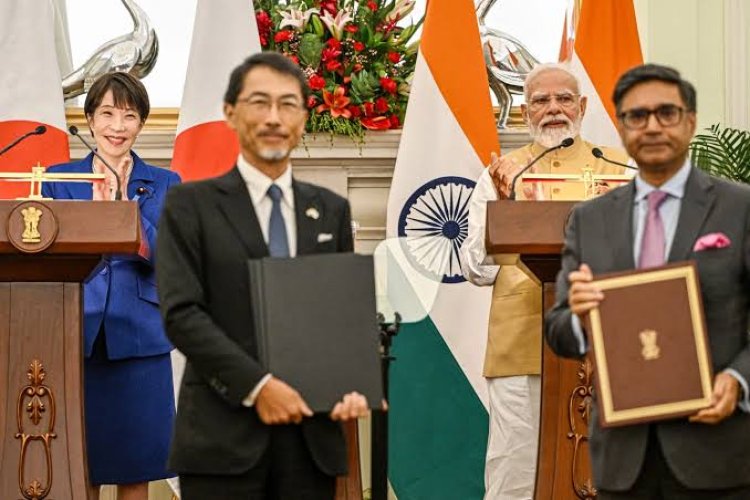
Analysis
By: Gilles Touboul
Some alliances attract attention. Others develop quietly. The relationship between Japan and India belongs to the second category. It is not a traditional military alliance. It is not based on a formal defense commitment, and neither country presents it as the beginning of a new political bloc. Yet it is gradually becoming one of the most important strategic relationships in Asia. Tokyo and New Delhi are getting closer because they both have to deal with the same fundamental issue: how can Asia stop a single force from controlling the whole region? China is that power. Official remarks don't always specifically address China. Nonetheless, it continues to lurk in the background of nearly all meaningful conversations between Japan and India over the Indo-Pacific's future.
This makes their collaboration especially intriguing. It is not an ideological or sentimental alliance. It is predicated on shared necessity, location, and strategic prudence. Japan contributes cutting-edge technology, capital, industrial know-how, naval prowess, and a solid security partnership with the US. India contributes its size, population, strategic depth, location in the Indian Ocean, and, most importantly, its history of political independence. Despite their differences, these attributes work well together.
The China Factor
This partnership is growing deeper and more strategic, according to the 16th Japan-India Annual Summit in New Delhi. Cooperation in defense and security, economic security, energy resilience, technology, innovation, and interactions between the two societies were the main topics of discussion. These topics might seem technical at first. They actually characterize the new language of power.
Armies, borders, and military installations are no longer the only aspects of geopolitics. Supply chains, ports, satellites, semiconductors, artificial intelligence, vital minerals, and maritime routes are all included. A significant portion of Japan and India's increasing collaboration can be attributed to China.
China is exerting pressure on Japan in the Western Pacific, the East China Sea, and the area surrounding Taiwan. China's influence is seen by India in South Asia, the Indian Ocean, and the Himalayan frontier. China is mostly visible to Japan from the sea. China is visible to India from both the ocean and the mountains. Although their geographical locations differ, their strategic concerns are becoming to resemble one another.
Recent Chinese military activity near Japanese waters has strengthened this concern. Japan protested after a Chinese destroyer carried out live-fire exercises in waters that Tokyo considers part of its exclusive economic zone. Such incidents do not necessarily lead to war. However, they change the strategic atmosphere. They remind Japan that maritime pressure is no longer a theoretical possibility. It is already part of the daily security environment in Asia.
The Sea as the New Strategic Map
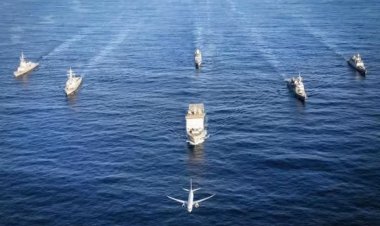
The strongest link between Japan and India is not ideology. It is the sea. The Indo-Pacific is not simply a diplomatic expression. It is a vast network of maritime routes, strategic passages, energy corridors, undersea cables, ports, naval bases and commercial flows.
The country that can protect these vital routes gains influence. The country that can threaten them gains political and strategic leverage. This is why India is so important to Japan. Japan depends heavily on secure maritime routes for its energy supplies and international trade. India is located near the major sea lanes connecting the Gulf, Africa, Southeast Asia and East Asia.
Its geographic position cannot easily be replaced by any outside power. For Tokyo, India is therefore much more than a large market. It is also an essential strategic partner in the Indian Ocean. For India, Japan offers something different but equally valuable. Japan provides technology, financing, infrastructure expertise, naval knowledge and a serious long-term approach. India wants to strengthen its domestic industry, modernize its defense sector and reduce its dependence on a limited number of foreign suppliers.
In November 2024, India and Japan signed a Memorandum of Implementation for the co-development of the UNICORN (Unified Complex Radio Antenna) mast for Indian Navy ships. The system integrates communication equipment into a single mast, improving the stealth characteristics of naval platforms. It will be co-developed in India by Bharat Electronics Limited with Japanese collaboration and, once implemented, will represent the first co-development and co-production project in defense equipment between the two countries.
The project also reflects a wider strategic shift. Japan's 2022 National Security Strategy places a Free and Open Indo-Pacific at the center of national policy and calls for deeper cooperation with India, both bilaterally and through the Quad. UNICORN is therefore more than a technical procurement program. It turns strategic convergence into a concrete industrial and maritime capability.
Japan can back this goal without making India think that it is trying to control its strategic choices. This is a very good thing. India is okay with partnerships, but not with political dependence. Japan seems to be able to understand this difference.
Now, economic safety is safety.
Economic security is the second reason why this partnership is important. This phrase may sound complicated, but it is now one of the most important ideas in geopolitics. Even if a country has strong walls, it can still be at risk. This country can become weak if too many of its supply chains rely on one country, if its energy routes are open, or if all of its technology comes from one foreign source.
Japan and India are aware of this fact. There should be more reliable supply lines, safer energy routes, and better industrial cooperation between the two countries. Their talks about technology, biogas, important minerals, economic security, and artificial intelligence (AI) show that their friendship is more than just formal meetings.
There are now institutions in place to support this teamwork. The governments of India and Japan signed a Memorandum of Cooperation on the India-Japan Semiconductor Supply Chain Partnership in July 2023. They also set up a Semiconductor Policy Dialogue that includes government agencies, businesses, and schools. They signed the India-Japan Digital Partnership 2.0 at the 2025 Annual Summit. This expanded their work together to include digital public infrastructure, digital talent, and joint study in AI, the Internet of Things, and semiconductors. These mechanisms matter because they turn the abstract goal of diversification into regular policy and industrial and research cooperation.
It now extends to factories, research laboratories, ports, energy systems and digital infrastructure. These are the areas where national power is increasingly built.
China has demonstrated that economic dependence can become a form of political pressure. The answer is not necessarily complete economic separation. Such a policy would be costly and probably unrealistic. The more practical answer is diversification.
India offers Japan a large market, an alternative industrial base and a rapidly developing technological sector. Japan offers India investment, technical expertise, industrial methods and international credibility. By working together, both countries can reduce their vulnerabilities without declaring an economic war against China.
However, the business connection is still noticeably uneven. The India-Japan Bilateral Brief states that although bilateral trade reached US$27.48 billion in FY2025–2026, only US$6.04 billion came from Indian exports to Japan, while US$21.44 billion came from imports. The numbers show both advancement and a drawback: trade integration is not keeping up with the pace of strategic convergence.. The next stage of the partnership should therefore be measured not only by the number of agreements, but also by whether India can expand higher-value exports and whether Japanese investment creates deeper industrial linkages inside India.
India's Autonomy, Japan's Discipline
The Japan-India relationship also works because the two countries do not think in exactly the same way. Japan remains deeply connected to the American alliance system. Its security strategy is closely linked to cooperation with the United States.
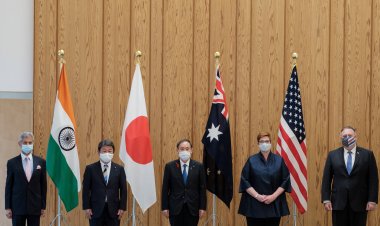
India also works with the United States, Japan and Australia through the Quadrilateral Security Dialogue, known as the Quad. However, New Delhi refuses to become a subordinate ally. India wants cooperation without dependence. It wants partnerships without losing its freedom of action.
This position sometimes frustrates India's partners. Some governments would prefer New Delhi to adopt clearer and more predictable positions. Yet India's strategic autonomy is also one of its main strengths. An India that was completely aligned with Washington would perhaps be easier to understand. But it would also lose part of its influence among countries in the Global South.
India can speak with the West, cooperate with the United States and Japan, maintain relations with Russia and continue presenting itself as an independent power. This gives the Japan-India partnership a wider political meaning.
It shows that concern about Chinese power is not only an American or Western concern. It is also an Asian concern, shared by major countries that want to preserve their own freedom of action. Japan contributes another important quality to this relationship: patience. Tokyo rarely makes dramatic announcements. It generally advances through institutions, financing mechanisms, industrial projects, infrastructure programs and gradual defense cooperation.
From the outside, this method can appear slow. But strategic competition in Asia will not be decided in a few months. It will continue for many years. In such an environment, patience and method may be more useful than noise.
Not a Formal Alliance, but a Strategic Insurance Policy
Japan and India are not trying to create an Asian version of the North Atlantic Treaty Organization. They are building something more flexible: a strategic insurance policy. They do not need to agree on every international issue. They simply need to cooperate in areas where their interests already meet and where cooperation makes both countries less vulnerable.
Both countries can work together on maritime security, technology, infrastructure, supply chains and defense production without creating a rigid military bloc. This may be the future of many partnerships in the Indo-Pacific. They will not always resemble the alliances created during the twentieth century. They may not include automatic military commitments or formal defense treaties. Instead, they will be built through naval exercises, investment corridors, satellite programs, port projects, critical-mineral agreements, cyber dialogues and industrial cooperation. The alliance of the twenty-first century may not always be defined by a treaty. It may be defined by a network.
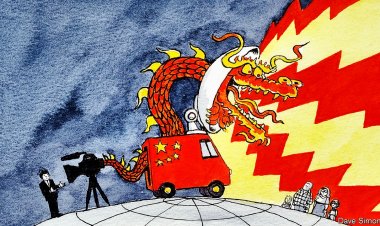
For China, this may be the real difficulty. The more Beijing uses political, military or economic pressure, the more it encourages other countries to cooperate. Japan and India have different histories, different political cultures and different relationships with the United States. Yet China's growing assertiveness is pushing them towards practical cooperation.
By seeking to become the central power in Asia, China may also be helping to create the partnerships that will limit its freedom of action. This does not mean that Japan and India want confrontation with Beijing. Neither country has an interest in an open conflict. However, both want to make sure that China cannot impose its choices on the rest of Asia without facing political, economic and strategic resistance.
Conclusion and Recommendation
Japan and India should not try to transform their partnership into a rigid military alliance. Such a decision would create unnecessary political tensions and would not correspond to India's strategic culture. Instead, Tokyo and New Delhi should continue to deepen their cooperation in the areas where their interests already meet: maritime surveillance, naval exercises, secure energy routes, joint defense production, critical minerals, trusted technologies, artificial intelligence and infrastructure connectivity.
This is where their partnership can become a real source of power. Not by making promises that neither country is ready to keep, but by developing regular habits of cooperation. Not by publicly naming China in every statement, but by making political and military pressure more difficult and more costly.
Not by emulating Western alliance models, but by creating a more flexible Asian form of strategic balance. The Japan-India alliance remains silent because it does not need to make noise. It observes China through geography, industry, technology and patience. In the Indo-Pacific, this quiet form of power may eventually become one of the most important.
Disclaimer: This paper is the author's individual scholastic contribution and does not necessarily reflect the organization's viewpoint.
Author bio: Gilles Touboul is a geopolitical analyst and the founder of Flashpoints. He writes about strategic trends, competition between major powers, energy security and the changing nature of international alliances.