The New Subversive Frontline: How Street Agitation Targets India’s Democratic Institutions
 usanasfoundation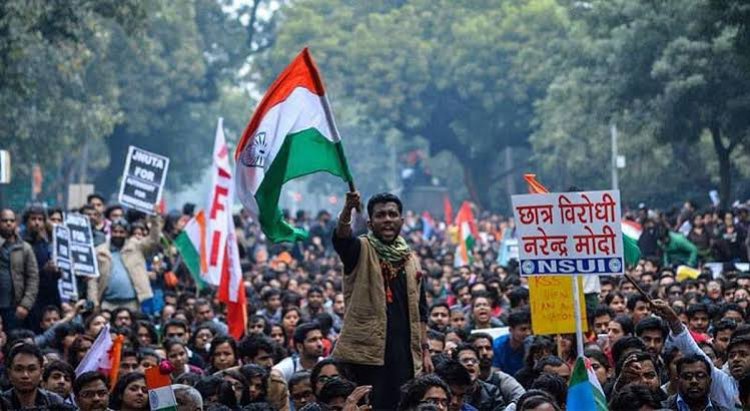
Commentary
By: Vaasu Sharma
The recently concluded demonstrations led by the Cockroach Janta Party in New Delhi, initially sparked by intensified well beyond ordinary peaceful student protests. Physical clashes with the police, destruction of public infrastructure, andensued from what had begun as a demand for administrative responsibility. The complaints of candidates impacted by examination flaws are completely justified. However, the fast transition from a protest against education policy to deliberate urban unrest adheres to a typical operational pattern, often converting specific administrative weaknesses into tools for broader political disturbance.
The Strategy of Manufactured Disruption
This systematic escalation is consistent with the political jujitsu or dilemma action framework that political scientists have described, whereby non-state actors use provocative tactics designed to compel state authorities to respond, changing the public narrative from the original grievance to alleged state overreach. This theoretical perspective seeks not administrative solutions but institutional stagnation and narrative capture. But the pattern that was observed in recent demonstrations needs a well-practised escalation approach. s are systematically decontextualized and reframed as proof of pervasive governmental oppression. Also often recruited for organizational support are activist networks that are said to include student groups. Coordinated online campaigns are said to magnify public sentiment to maintain momentum. The strategic value here is the asymmetry of such tactics. Protest organizers can elicit institutional responses at relatively low cost, and the level of public outrage seems often selective, depending more on political context than the seriousness of the underlying issue. Paper leaks is a systemic issue, and these are chronic governance challenges which need technical and institutional remedies regardless of who is in power. However, the amount of public indignation is rarely determined by the gravity of the mistake itself; rather, it varies substantially depending on the political affiliation of the administration in power. When opposition-ruled states fail, there is relative silence, but when the same errors occur at the national level, they are promptly seized upon to demand extra-parliamentary confrontation and the resignation of constitutional authorities.
Beneath this selective resentment, the operational architecture of manufactured disruption depends upon a highly planned strategy of physical escalation and institutional paralysis. Once public sympathy is sparked for an administrative grievance, the emphasis quickly turns from productive conversation to forced direct confrontations with state authorities. Tented sit-ins, extended blockades of major transit arteries, and provocative marches to , which is then selectively edited and disseminated to create an impression of state overreach. Rather than pursue restitution through established statutory systems or court appeals or parliamentary channels, the leadership of such groups advocates a maximalist position eschewing compromise. Keeping the struggle alive helps activist networks maintain high visibility, instill a sense of perpetual crisis among impressionable youth, and build momentum for broader political goals that extend far beyond the initial
Imported Ideologies and Institutional Erosion
Ideological frameworks are the key to understanding why these mobilizations in India always choose street force over political methods. There have been numerous observations by observers about the perceived dominance of certain ideological leanings in parts of Indian academia, central universities and the civil society ecosystem. However, it must be said that these institutions are still intellectually diverse and not defined by any one political point of view. Rather than seeing the contemporary Indian republic as a space of negotiated reform, these imported frameworks perceive it as an inherently oppressive apparatus that must be perpetually discredited. In this view, India’s constitutional systems are mere vehicles of power, progressive policy reform is rejected in favor of constant friction, and local Indian civilizational norms are seen as regressive barriers to a top-down ideological agenda. Such movements reduce complicated socio-economic realities to hard binaries of victimhood and oppression, which gradually erodes trust in Indian democratic institutions and alienates young minds from their civic responsibilities and national identity.
A historical and cultural process of alienation within the Indian setting is the mechanism via which this ideological deterioration functions. Adversarial foreign-derived analytical lenses systematically downplay or re-interpret the old Indian social order, indigenous ideologies like Sanatan Dharma and ancient Indic philosophy and prior civilisational achievements.. This tendency, observable in certain academic and activist discourses, encourages a critical posture toward indigenous traditions that may not always be balanced with an appreciation of their civilisational contributions. Regression is linked with national pride and patriotism. Over time, this psychological distancing takes its toll, eroding the organic ties that hold a varied Indian community together and replacing shared civic purpose with fractured identity politics. Such psychological detachment, if left uncontrolled, may over time rupture the social fabric. The long-term repercussions of exposing young minds to narratives that stress grievance over responsibility, confrontation over conversation may be substantial for national cohesion.
External Networks and the Foreign Funding Channel
This internal machinery of subversion does not operate in a vacuum. In certain instances, it has been reportedly abetted by foreign networks and financial conduits that have targeted India. Global NGOs, corporate foundations, and foreign funding mechanisms have at times operated under the noble banners of environmental protection or human rights while allegedly channelling funds to influence domestic policy decisions in developing countries like India. In support of the Foreign Contribution (Regulation) Amendment Act 2020, the Supreme Court of India noted that “the inflow of foreign contribution had almost doubled between the years 2010 and 2019” and that many registered associations had failed to comply with statutory formalities, resulting in the cancellation of certificates of registration of more than 19,000 organisations a “staggering number indicative of gross violations”. “In some cases, unrestricted foreign funds have reportedly been used to undertake sustained campaigns against key national infrastructure, energy advancements and strategic initiatives of India,” it said, effectively raising worries about economic progress and sovereign decision-making. The Foreign Contribution (Regulation) Act (FCRA) and other stringent statutory frameworks are important safeguards against foreign capital being a potential parallel source of funds for political destabilisation in the country, and are meant to ensure that the workings of civil society in India are transparent and accountable to law.
The flexibility of these external funding ecosystems is not confined to direct protest mobilization but also includes policy warfare against the Indian state. These networks fund selective research, influence foreign legislatures and generate targeted media narratives to persuade India to give in to foreign geopolitical interests. In certain instances, domestic activists and groups receiving foreign funding have been alleged to serve as potential force multipliers for foreign objectives by portraying sovereign Indian policy decisions as violators of international norms. Therefore, regulation of these financial inflows is not an attempt to restrict authentic charitable donations but a fundamental national security needs to ensure that India’s policy independence is not hijacked by ambiguous foreign interests.
Reclaiming the Civilizational Mainstream
Repeated efforts to enforce alien, confrontational beliefs directly endanger the social fabric and civilizational continuity of India. The frameworks based on external historical experiences of perennial conflict, hostility towards traditional social structures and erosion of local cultural ethos are fundamentally mismatched with a nation whose historical strength lies in pluralism, spiritual depth and organic continuity. Genuine civic participation is replaced by imported radicalism, which leads to social polarization and institutional paralysis. The answer to this menace lies in a strong state response, quick-fix administrative reforms using technology to address genuine public concerns, and a solid will to maintain law and order. Furthermore, educational and social institutions across India need to actively reorient themselves in India’s own civilizational wisdom and foster in future generations a sense of intellectual self-reliance, constructive duty and national pride.
To rebuild this cultural foundation, Indian families, schools and community leaders must work together to teach and promote critical thinking that is rooted in indigenous values. Instead of allowing young minds to be drawn into manufactured anger and ideological skepticism, the educational ecosystem in India has to concentrate on the balance between individual rights and public responsibilities. Thoughtful interaction with Indic literature, historical narratives and philosophical traditions can be a stabilizing force against polarizing forces If India is able to establish conditions for reform by constitutional methods, not through subversion at the street level, its youth would arguably be better positioned to contribute to national development rather than being drawn into potentially destabilising activities.
Conclusion
An intricate threat to the internal security and democratic integrity of India has emerged from the confluence of staged street protests, foreign radical ideology, and underground finance networks. Governance and examination issues have always been there, and valid grievances must be attended to with due urgency and transparency. However, it is unfathomable to overlook the possibility that some of these issues are being exploited to weaken state institutions. With its own constitutional procedures and cultural ethos, India has been able to settle internal disputes, which has been its lasting strength. Strengthening regulatory monitoring, enforcing the rule of law and re-anchoring the country's youth in national values and civic responsibility will help India protect its democratic framework from the corrosive impact of foreign ideological subversion, and assure long-term national cohesiveness.
Disclaimer: This paper is the author's individual scholastic contribution and does not necessarily reflect the organization's viewpoint.