How BRICS went from being a supporting actor to a lead actor
 usanasfoundation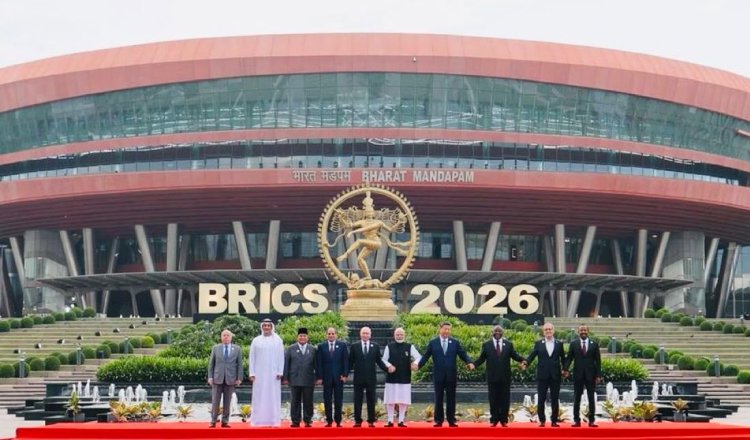
Analysis
By: Ameya Kulkarni
A decade ago, the debate around BRICS was predicated on the US leading the restructuring of the world economy, with BRICS as a supporting actor in this order-building process.
But the rapid decline of the US and its relentless weaponisation of public goods, including financial and trading networks, has dramatically changed the context. The US has not merely abdicated its leadership; it has become a spoiler. Other rising powers are being impelled to step forward to prevent a total breakdown or fragmentation in the international system.
BRICS is the only multilateral institution today that seeks to uphold interconnections between diverse economies without the overhang of geopolitical pressure or prejudice.
As the G-7 economies have reduced their relative weight in the global economy, the major developing powers of the non-West are becoming an important stabilising force. Over the past two decades, intra-G-7 trade has only doubled while intra-BRICS trade has expanded more than 13 times. Equally striking is the transformation in global consumption. In 2000, the G-7 was the sole centre of demand, accounting for 45% of world merchandise imports (BRICS + was 11%).
By 2025, G-7’s share declined to 25%, and BRICS + rose to 17%. Fast forward this trend line to 2035 to imagine an Asian and Eurasian-centred globalisation 2.0.
In the past, a slowdown and protectionist policies in the US would have quickly escalated to numerous crises in the Global South. But today, the negative impact of the double whammy of tariffs and geopolitical mayhem from the West has been cushioned by the existence of BRICS and the individual resilience of its members. This is a reflection of the emerging multipolar age.
The ideas and norms that will guide this emerging world order will emanate from the non-Western world. This has not occurred previously — at least not for the past 500 years when the West was at the helm — which makes the historical process novel as well as uncertain. The texture of these ideas is still evolving. BRICS can be seen as a legitimate platform for the emerging order because it transcends national temperaments and diverse preferences towards a common normative setting. This is the purpose of genuine multilateral institutions: they enable members to co-create rules and networks that become public goods.
Yet, BRICS must always be historically conscious to avoid repeating the fates of Western powers that could not resist abusing their primacy. The lessons of world history must guide the new multipolar age to ensure a decisive break from the pattern of neo-colonial pressures, incessant geopolitical competition and military confrontations towards a more inclusive and balanced world where the major powers wisely bear their responsibilities for order-building.
BRICS members are also under no illusion that multipolarity will be handed over to them on a silver platter by the declining powers. There will be competition and turmoil when power shifts occur. This is history reminding us of certain hard truths. The aim is to prevent this process from descending into reckless competition and outright conflict. Xi and Modi are now demonstrating that India-China differences will not prevent them from fulfilling their roles as stakeholders in the multipolar age and steering it in a positive and sustainable direction.
Some BRICS members, like Iran, have been left with no choice but to resist aggression and preserve their security and sovereignty. We should not undervalue the roles of resistance by the frontline defenders of a multipolar order.
In contrast, China and India’s roles are to cushion the world economy during this phase of turbulence and promote more sophisticated avenues of interdependence that cannot be easily disrupted by other actors.
By supplying public goods, China and India can tilt the world balance towards a legitimate concept of order that attracts more sovereign states. More broadly, this complex division of labour within BRICS — that some members are fated to resist because of their geopolitical location and some are obliged to create the norms and mechanisms — is understood by all the key players. Indeed, it is because of this division of labour that each member can play its role effectively today.
The naysayers would prefer that BRICS remain an eloquent talk shop that fumbles its way and squanders a unique window of opportunity to advance the true multipolarisation of the world economic system, an outcome that ironically would condemn the Global South, including India, to a state of underdevelopment for another generation.
Disclaimer: This paper is the author's individual scholastic contribution and does not necessarily reflect the organization's viewpoint.